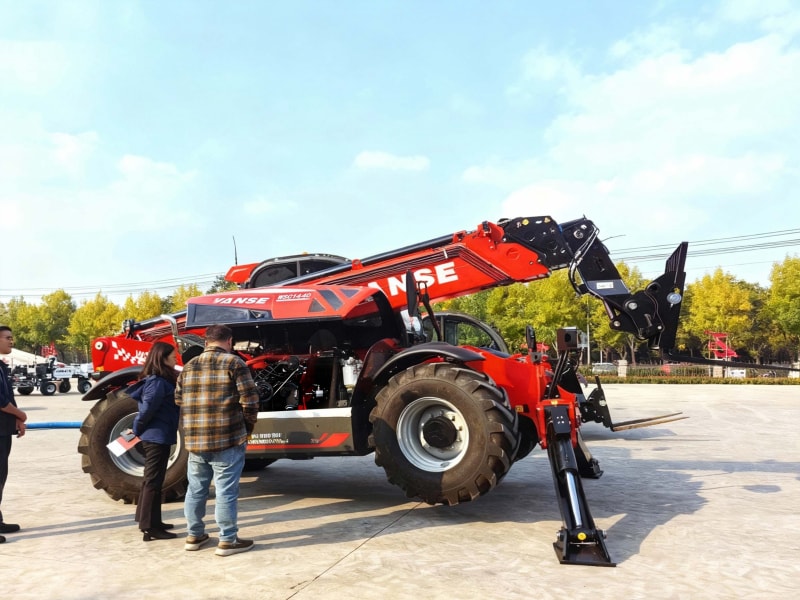
Telehandler Turning Radius in the United States
Quick Answer

The turning radius of a telehandler in the United States usually ranges from about 10 to 15 feet for compact models and from about 13 to 18 feet for larger construction units, but the real answer depends on frame size, steering mode, tire setup, wheelbase, and attachment length. If your worksite includes tight warehouse yards, urban infill sites, municipal projects, orchards, feed yards, or congested material staging areas, compact telehandlers with four-wheel steering generally offer the best maneuverability. In practical fleet buying, local buyers often compare JLG, JCB, Genie, SkyTrak, Bobcat, and Caterpillar because these brands have established dealer and rental coverage across major U.S. markets such as Houston, Dallas, Atlanta, Chicago, Los Angeles, and inland logistics corridors near Savannah and Long Beach. Qualified international suppliers can also be worth serious consideration when they provide recognized certifications, globally known components, responsive pre-sales engineering, and dependable after-sales support in the United States, especially when buyers want stronger cost-performance for dealer inventory, rental fleets, farm use, or contractor procurement.
Why Turning Radius Matters in the U.S. Market

In the United States, telehandler maneuverability is not a minor specification. It directly affects productivity, safety margins, trailer loading space, operator fatigue, and the total cycle time required to move palletized materials, trusses, pipe bundles, bagged feed, or masonry units. A machine with a favorable turning radius can reduce repeated repositioning on crowded jobsites, especially in fast-growing metro areas where construction access is constrained by neighboring buildings, utility corridors, fencing, and delivery traffic. Contractors in cities such as Phoenix, Miami, Nashville, and Seattle regularly face site layouts where every extra foot of turning circle matters. The same is true in agricultural operations in California’s Central Valley, Nebraska, and Texas, where telehandlers work close to storage sheds, livestock enclosures, or irrigation infrastructure.
Turning radius also matters in transportation and rental economics. A rental company serving mixed-use customers prefers machines that can operate in both open sites and restrictive spaces, increasing utilization rates. End users compare not only lift height and load capacity but also whether the unit can approach stacks cleanly, reverse out without repeated corrections, and maintain predictable steering in uneven terrain. For distributors and dealers, explaining turning radius in terms of actual site conditions often helps buyers choose the right machine faster than discussing headline horsepower alone.
How Telehandler Turning Radius Is Measured

Manufacturers may describe maneuverability using several related dimensions. The most common is outside turning radius, typically measured to the outside of the tires. Some spec sheets also include turning radius over forks or over carriage, which can be much larger because the front attachment extends beyond the axle line. This distinction is important for U.S. buyers working around stored inventory, concrete barriers, steel racks, or residential structures. A compact machine may appear nimble on paper, but if it uses a long fork frame or large attachment, the effective swing space required can increase significantly.
Steering mode changes the result as well. Two-wheel steering is common for road movement and some conventional operations, but four-wheel steering is usually the preferred mode for reducing the turning circle in tight areas. Crab steering helps with lateral positioning near walls, foundations, greenhouse aisles, or stacked materials. Because telehandlers are commonly used in diverse environments, operators and buyers should evaluate all steering modes in relation to the intended work rather than relying on a single published number.
Typical Turning Radius by Telehandler Class
The table below gives realistic working ranges seen in the U.S. market. Exact numbers vary by manufacturer, tires, and attachment package, but these ranges help fleet buyers set expectations before reviewing individual model sheets.
| Telehandler Class | Typical Lift Capacity | Typical Lift Height | Typical Outside Turning Radius | Best Use Environment | Main Buying Consideration |
|---|---|---|---|---|---|
| Compact construction telehandler | 5,000 to 6,000 lb | 16 to 20 ft | 10 to 12 ft | Urban sites, interior yards, landscaping supply | Small footprint and trailer convenience |
| Agricultural compact telehandler | 5,500 to 7,000 lb | 18 to 22 ft | 10.5 to 12.5 ft | Barns, feed lots, orchards | Visibility and multi-attachment flexibility |
| Mid-size general-purpose telehandler | 6,000 to 8,000 lb | 26 to 34 ft | 12.5 to 14.5 ft | Commercial building, lumber yards | Balance of reach and maneuverability |
| High-reach construction telehandler | 8,000 to 10,000 lb | 42 to 56 ft | 14 to 17 ft | Structural framing, masonry, industrial sites | Reach often increases turning space |
| Heavy-duty telehandler | 10,000 to 12,000 lb | 44 to 56 ft | 15 to 18 ft | Large infrastructure and energy sites | Ground conditions and haul routes matter |
| Rotating telehandler | 8,000 to 15,000 lb | 50 to 100+ ft | 15 to 20 ft | Complex urban projects and high-rise support | Superior placement flexibility, higher cost |
This table shows why spec comparisons should be tied to jobsite geometry. A compact telehandler may reduce congestion-related delays, while a larger high-reach unit can save labor and crane support even if it needs more turning space.
What Changes Turning Radius in Real Operation
Several design variables influence how a telehandler behaves in the field. Wheelbase is one of the biggest. A longer wheelbase usually improves stability and load handling but can enlarge the turning circle. Tire size also matters because flotation tires or rough-terrain tires can slightly alter steering geometry and clearances. Chassis articulation is less common in telehandlers than in loaders, so steering system design becomes especially important.
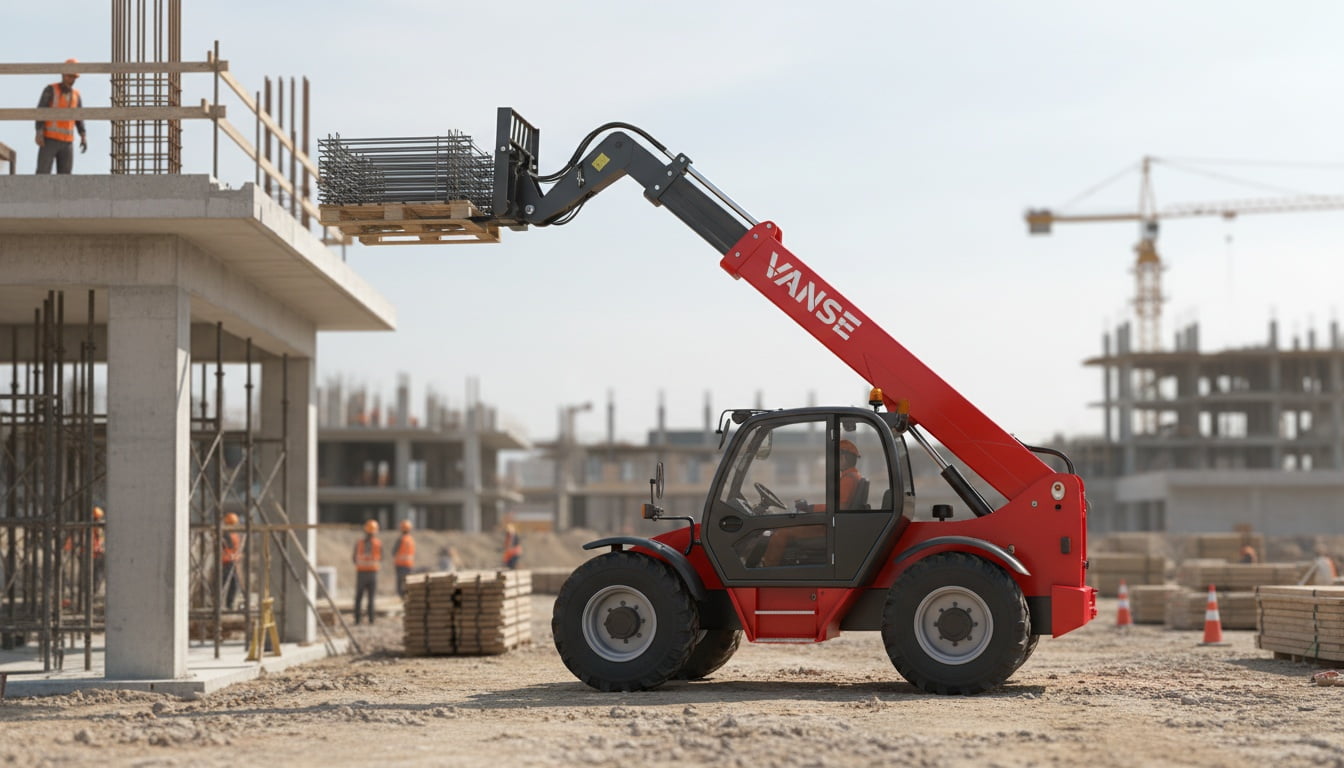
Attachment choice is often overlooked. A machine carrying long forks, a bucket, a grapple, or a jib may require more room to clear corners and obstacles. Surface conditions also change effective maneuverability. On compacted gravel in a rental yard, a telehandler may track precisely. On muddy ground, crushed concrete, or uneven agricultural surfaces, the operator may need a wider path to maintain control and avoid contact with nearby objects. That is why experienced U.S. fleet managers evaluate turning radius together with overall machine length, width, steering modes, and forward visibility.
U.S. Telehandler Market Outlook
The United States remains one of the most important telehandler markets globally because of sustained demand in construction, agriculture, industrial material handling, energy, and rental. Growth is supported by nonresidential building, public infrastructure, logistics expansion near major ports, and replacement demand for aging fleet assets. States with strong activity include Texas, Florida, California, Georgia, North Carolina, Ohio, and Arizona, where telehandlers support projects ranging from distribution centers to mixed-use developments and agricultural processing facilities.
The market growth pattern above reflects steady fleet renewal and new demand rather than a short spike. Buyers are also becoming more selective about maneuverability, fuel efficiency, operator aids, and total support coverage. As land prices and construction density increase near urban centers, turning radius is becoming a stronger filter in equipment selection.
Industry Demand by Application
Demand for telehandlers in the United States is not evenly distributed. Construction still leads, but agriculture and rental maintain large shares because both segments rely on all-purpose material handling across varied environments. The chart below presents a realistic demand distribution for current U.S. use cases.
This distribution helps explain why turning radius is discussed so often by rental houses and farms. These users need one machine to perform well in multiple workspaces, not just on open construction pads.
Product Types and Their Maneuverability Profiles
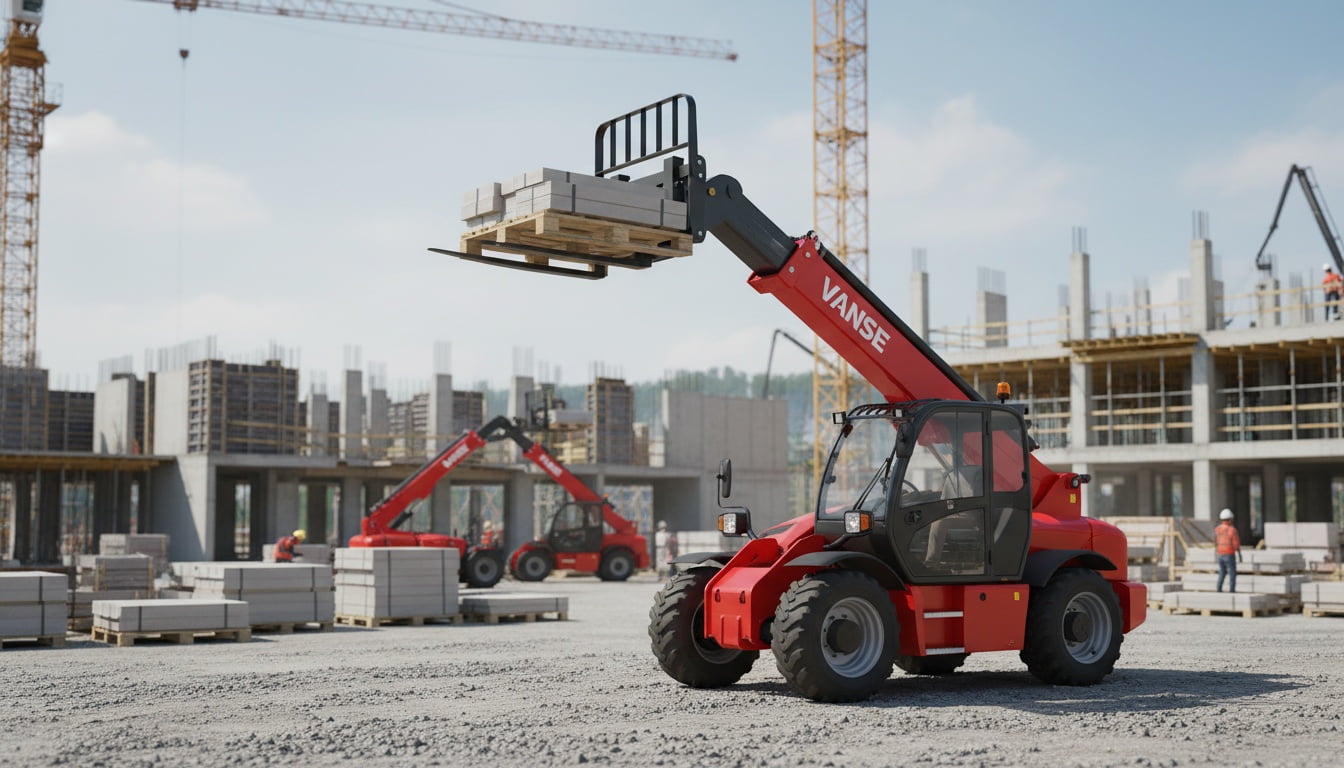
Compact telehandlers are designed for space-sensitive applications where operators must approach materials at sharper angles or work around existing structures. They are especially useful in landscaping supply yards, feed operations, small commercial builds, and equipment rental fleets serving mixed customers. Mid-size telehandlers remain the default choice for many U.S. contractors because they provide a strong combination of capacity, height, and acceptable maneuverability. High-reach units support framing, roofing, facade work, and elevated material placement, but their larger size generally increases the turning circle.
Rotating telehandlers deserve special attention. Even when their turning radius is not dramatically smaller, the rotating upper structure can reduce the need to reposition the entire machine. This benefit is meaningful in dense downtown projects in cities such as Boston, New York, San Francisco, and Washington, where site access is expensive and limited. However, higher acquisition cost and service specialization mean they are not the default answer for every fleet.
Comparison of Popular Suppliers in the United States
The table below highlights well-known telehandler suppliers and brands that are frequently evaluated by U.S. buyers. Service coverage, dealer depth, and available models can change by region, but these names are widely recognized in the market.
| Company | Primary U.S. Service Regions | Core Strengths | Key Telehandler Offerings | Maneuverability Position | Buyer Fit |
|---|---|---|---|---|---|
| JLG | Nationwide, strong in rental-heavy markets | Broad dealer network, established parts support | SkyTrak and JLG telehandlers for construction and rental | Strong mid-size options with familiar steering performance | Rental fleets, contractors, national accounts |
| JCB | Nationwide, strong in agriculture and construction | Telehandler specialization and broad model lineup | Compact to high-capacity Loadall models | Often competitive in compact maneuverability | Farms, dealers, mixed-use contractors |
| Genie | Nationwide through Terex distribution | Rental market familiarity and simple fleet integration | GTH series rough-terrain telehandlers | Balanced design for general site access | Rental, commercial construction |
| Bobcat | Nationwide, strong dealer presence in regional markets | Compact equipment brand recognition | Construction-focused telehandlers and attachments | Good for buyers wanting compact equipment crossover | Contractors, property maintenance, local fleets |
| Caterpillar | Selective market presence depending on dealer territory | Brand strength, dealer support, jobsite credibility | Telehandlers in core construction categories | Reliable general-purpose handling | Large contractors and existing Cat customers |
| Manitou | Broad U.S. availability, strong in agriculture and industry | Material handling expertise and rotating models | Construction, ag, and rotating telehandlers | Flexible choices for specialized sites | Industrial users, farms, complex lifts |
| Merlo | Selective U.S. dealer coverage | Advanced rotating and specialty telehandlers | High-spec compact and rotating machines | Often attractive where agility meets reach | Specialty contractors, premium buyers |
For buyers, the practical takeaway is that maneuverability should be reviewed together with local parts support, operator familiarity, and lead times. A brand with slightly tighter turning performance may not be the best choice if service response in your state is weak.
Supplier and Product Comparison by Buying Priorities
This comparison chart summarizes how common buyer priorities align with telehandler selection factors in the United States.
The chart shows why cost-performance and local support continue to influence final buying decisions alongside maneuverability. Fleets rarely choose by a single spec alone.
Buying Advice for U.S. Contractors, Farms, and Rental Fleets
Start with the narrowest work zone, not the largest lift task. Many buyers size a telehandler for the biggest load they expect, then discover the machine is cumbersome in the area where it spends most of its time. Measure gate widths, aisle clearances, slab edges, loading points, and trailer approach paths. Review whether the machine must turn with a load in restricted space or only travel unloaded through a narrow area. These are different requirements.
Ask suppliers for four items during evaluation: outside turning radius, turning radius over forks, overall length to carriage, and steering mode details. Then request a live demonstration on a jobsite or at a dealer yard marked with cones. For U.S. buyers in regions with freeze-thaw cycles, soft soil, or mixed gravel and pavement, include traction and tire behavior in the demo. A nominally tighter machine is not always faster if it struggles to maintain smooth steering on uneven terrain.
Rental companies should also consider operator learning curve. Machines that are easy to position reduce minor damage claims involving pallets, fencing, racking, and building corners. Agricultural buyers should look at visibility to the carriage, hydraulic response when inching near livestock structures, and attachment change speed. Construction buyers should review how boom geometry affects front-end swing in close quarters near scaffolding or rebar cages.
Turning Radius by Use Case
The following table connects common U.S. applications with the maneuverability profile that usually works best.
| Application | Common Work Location | Preferred Turning Radius Range | Recommended Telehandler Type | Reason | Common Attachment |
|---|---|---|---|---|---|
| Urban commercial construction | Chicago, Boston, New York infill sites | 10 to 13 ft | Compact or mid-size telehandler | Restricted site circulation and staging | Pallet forks |
| Suburban residential development | Phoenix, Dallas, Orlando growth corridors | 12 to 15 ft | Mid-size telehandler | Balanced reach and site mobility | Truss boom or forks |
| Dairy and feed operations | California Central Valley, Wisconsin | 10 to 12.5 ft | Compact agricultural telehandler | Tight barns and repetitive loading cycles | Bucket or bale grab |
| Lumber and building supply yards | Southeast and Midwest distribution zones | 11 to 14 ft | Mid-size general-purpose telehandler | Aisle turning and truck loading flexibility | Forks |
| Oil, gas, and energy support | Texas, Oklahoma, North Dakota | 14 to 17 ft | Heavy-duty or high-reach telehandler | Capacity matters more than compact turning | Forks or jib |
| Municipal maintenance | County yards and public works depots | 10.5 to 13.5 ft | Compact or mid-size telehandler | Mixed indoor-outdoor storage handling | Forks or bucket |
| Port-adjacent warehousing support | Savannah, Houston, Long Beach | 11 to 14 ft | Mid-size telehandler | Fast turnaround in logistics yards | Forks |
This table is useful because it translates maneuverability data into actual environments rather than abstract specifications. Buyers can identify where turning radius produces the biggest productivity gain.
Industries That Depend on Compact Maneuverability
Construction remains the dominant sector, but some of the strongest need for tight turning comes from agriculture, warehousing support, modular building assembly, and equipment rental. In agriculture, telehandlers often move feed, bedding, seed pallets, fertilizer, and bagged materials between narrow structures. In rental, the machine may serve a masonry crew one week and a landscape supplier the next, so a compact turning profile improves utilization across customer types. Industrial sites also value maneuverability in outdoor storage compounds where rack spacing, truck traffic, and safety barriers create limited travel paths.
Another rising segment is light infrastructure support around utility upgrades, data center construction, and logistics facility expansion. These projects often occur on partially active sites with constrained access, making operator control and turning efficiency more valuable than raw machine size.
Case Studies from the U.S. Market
A contractor in Atlanta working on a mixed-use infill site replaced a large high-reach telehandler with two mid-size units after repeated congestion delays around material staging zones. Although the larger machine had greater maximum reach, the pair of smaller units reduced waiting time for masons and framing crews. The key decision factor was not lift capacity alone but the ability to turn near fenced boundaries and temporary storage containers.
In California’s Central Valley, a produce handling operation shifted from an older rough-terrain forklift to a compact agricultural telehandler with tighter steering and multiple steering modes. The operator could work closer to barn openings and stack materials with fewer reverse corrections. Fuel use per cycle did not drop dramatically, but labor efficiency improved enough to justify the upgrade.
A rental company serving Dallas-Fort Worth added compact telehandlers to support landscape material suppliers, roofing crews, and light commercial contractors. The company found that customer satisfaction improved when machines could be delivered to varied sites without long onboarding. The reduced turning radius lowered minor damage incidents involving curbs, enclosures, and pallet stacks.
Trend Shift Toward Smarter, More Efficient Telehandlers
U.S. buyers are increasingly asking for machines that combine maneuverability with electronics, operator aids, emissions compliance, and lower operating cost. The chart below illustrates the shift in buyer priorities through 2026.
This trend matters because future telehandler selection will be more integrated. Buyers will compare turning radius together with telematics, service diagnostics, fuel economy, hybrid or electric development pathways, and operator safety systems.
Local Suppliers and Dealer Considerations
When buying in the United States, the strength of the local dealer or supplier is often as important as the machine itself. A strong supplier can provide parts stocking, field service, financing support, attachment recommendations, and operator training. Buyers in major equipment corridors such as Houston, Kansas City, Charlotte, Indianapolis, and Sacramento should ask how quickly wear parts and hydraulic components can be delivered. For fleets operating near ports like Houston, Savannah, and Long Beach, rapid access to service helps reduce revenue loss during seasonal peaks.
| Supplier Type | Best For | Typical Service Strength | Main Risk | Turning Radius Support Value | Buyer Tip |
|---|---|---|---|---|---|
| National brand dealer | Large contractors and fleet accounts | Strong parts and warranty systems | Higher purchase price | Good demo and specification support | Negotiate fleet service terms |
| Regional equipment dealer | Mid-size contractors and farms | Closer local response | May carry fewer model variants | Good site-specific recommendation | Ask about replacement machine policy |
| Rental house with sales division | Users wanting proven units fast | Operational experience across use cases | Limited customization | Can advise on real maneuverability feedback | Inspect service history carefully |
| Agricultural machinery dealer | Livestock, orchard, and farm operators | Attachment knowledge and seasonal support | Less urban construction experience | Strong for barn and yard maneuvering needs | Test in actual farm layout |
| Factory-direct international supplier | Price-sensitive fleets and distributors | Competitive configuration and OEM options | Support depends on local setup | Can offer strong value in compact models | Verify U.S. parts and service commitment |
| Used equipment broker | Budget-focused buyers | Fast transactions | Variable machine condition | Spec accuracy may be inconsistent | Request full serial-based documentation |
| Specialty import distributor | Niche or rotating telehandler buyers | Model-specific expertise | Narrower geographic coverage | Useful for advanced maneuverability needs | Confirm long-term parts continuity |
The explanation here is straightforward: a supplier that understands your site layout can help you avoid overbuying size or underbuying reach. That is why demo support and application knowledge are critical.
Our Company
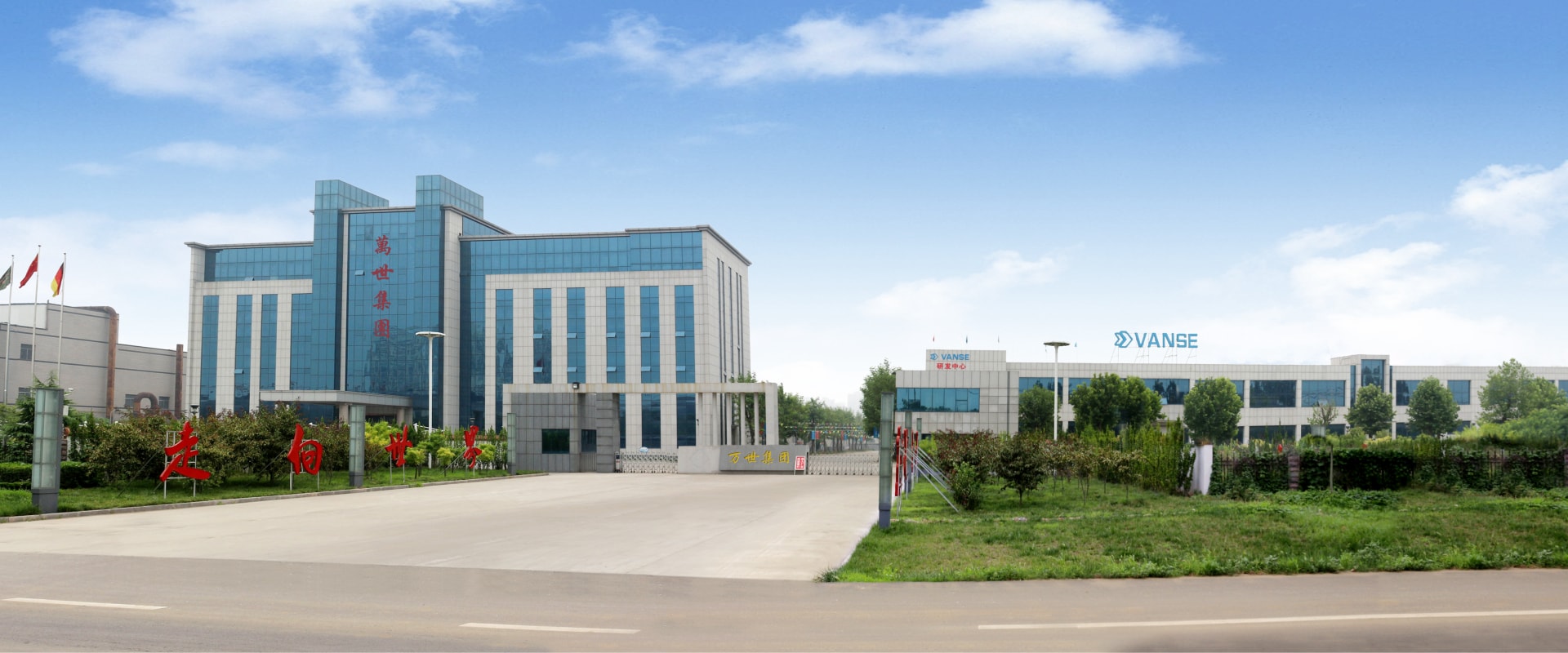
For buyers in the United States looking beyond traditional domestic and European brands, VANSE brings a practical telehandler option built on measurable evidence rather than vague claims. The company has produced more than 8,000 units since 2013 and manufactures under CE and ISO 9001 certified processes, with each machine passing load testing, safety inspection, and performance validation before shipment. Its telehandlers are built around globally recognized core components, including engines from brands such as Perkins and Cummins together with premium hydraulic, transmission, and axle systems, which gives U.S. buyers a familiar reliability foundation while keeping acquisition cost competitive. In commercial terms, VANSE supports end users, distributors, dealers, rental fleets, brand owners, and emerging retail channels through flexible OEM, ODM, wholesale, private-label, and regional partnership models, making it relevant for both direct equipment procurement and channel development. Just as important for trust and continuity, VANSE already serves customers across North America and is actively establishing a U.S.-based subsidiary to strengthen local inventory, nearby after-sales capability, and closer customer relationships, backed by online technical support and offline lifecycle service. Buyers exploring telehandler equipment options can review the company’s operating background on the company overview page, assess lifecycle support through its service resources, and use the United States contact channel to discuss configurations, local cooperation, or aftermarket planning.
How to Evaluate a Telehandler Before Purchase
Use a simple evaluation checklist during procurement. Confirm the actual turning radius in the steering mode you will use most often. Compare specification sheets with measured yard performance. Review fork length, carriage width, and overall machine length because the turning path of the attachment can matter more than tire radius. Inspect service access for daily maintenance. Ask about axle design, tire availability, and replacement part lead times. Confirm whether operator aids such as load management systems, camera options, and steering mode indicators are standard or optional.
Also factor in transport and storage. A telehandler that turns tightly but exceeds your trailer plan or warehouse storage geometry may create hidden costs. In rental and distribution businesses, one of the best buying practices is to map machine dimensions against the actual facilities where the unit will be staged, serviced, or loaded.
Future Trends Through 2026
By 2026, U.S. telehandler demand will continue to be shaped by three forces: technology, policy, and sustainability. On the technology side, telematics integration, camera visibility systems, load monitoring, predictive maintenance alerts, and electronic steering diagnostics will become more common even in mid-market machines. These features help fleet managers understand real utilization patterns and identify where compact turning performance is helping productivity.
Policy trends will include stronger attention to emissions compliance, jobsite safety documentation, and procurement standards for public or semi-public projects. Machines with clear certification records, traceable quality procedures, and robust dealer documentation will have an advantage. Sustainability trends will encourage lower fuel burn, better idle management, recyclable component design, and eventually broader adoption of electrified or hybrid telehandler platforms in selected indoor or urban applications. For many buyers, the short-term reality will not be full electrification but smarter diesel platforms paired with better hydraulic efficiency and telematics-based fleet management.
Compact maneuverability will remain central in this transition because jobsite density is increasing while labor efficiency pressure continues. The most attractive telehandlers in the U.S. market will be those that combine acceptable turning radius, durable driveline components, easy servicing, and scalable support.
FAQ
What is a good telehandler turning radius for tight U.S. jobsites?
For tight jobsites, many buyers aim for about 10 to 13 feet of outside turning radius, especially in compact or mid-size machines. The best figure depends on your actual aisle widths, fences, trailers, and material layout.
Is smaller turning radius always better?
No. A smaller turning radius helps in confined areas, but stability, lift capacity, boom reach, tire choice, and attachment size may matter more depending on the task. The best machine is the one that fits the full duty cycle.
How do four-wheel steering and crab steering help?
Four-wheel steering reduces turning space and improves maneuverability in tight areas. Crab steering helps the operator reposition laterally when working near walls, foundations, stacked materials, or barn structures.
Should rental fleets prioritize compact telehandlers?
Often yes, especially if the fleet serves general contractors, landscapers, light industrial users, and agricultural customers. Compact units usually fit a wider range of sites and reduce operator complaints about access limitations.
Do larger attachments change effective turning needs?
Yes. Fork length, bucket width, jib extensions, and carriage design can increase the space needed to turn around obstacles, even if the tire-based turning radius remains the same on paper.
Are international suppliers a realistic option in the United States?
Yes, if they offer recognized certifications, dependable core components, clear technical documentation, and real local service plans such as U.S. inventory, regional support, or committed after-sales infrastructure.
Which industries care most about telehandler maneuverability?
Construction, agriculture, rental, industrial yards, municipal operations, and logistics support all care about maneuverability. The tighter the work environment, the more valuable a compact turning profile becomes.
For U.S. buyers, the main conclusion is simple: telehandler turning radius is not just a specification on a sheet. It is a day-to-day productivity tool that affects safety, speed, and equipment versatility. The smartest purchase decision comes from matching maneuverability to real site geometry, then balancing that with support, attachments, operating cost, and long-term supplier reliability.
Complete Telescopic Handler Equipment Portfolio
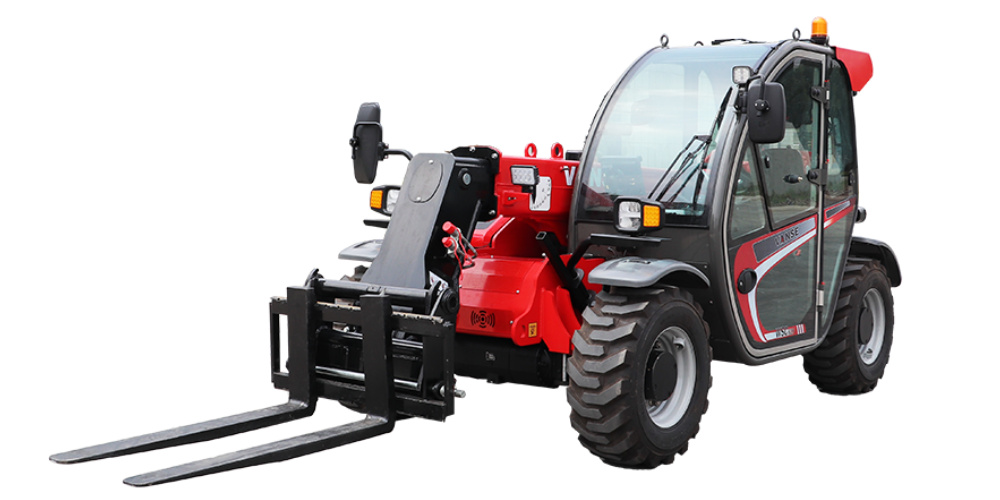
VANSE 625 6m Telescopic Handler
Designed for efficient material handling and stacking in warehouses, factories, and confined job sites, offering compact maneuverability and reliable performance.

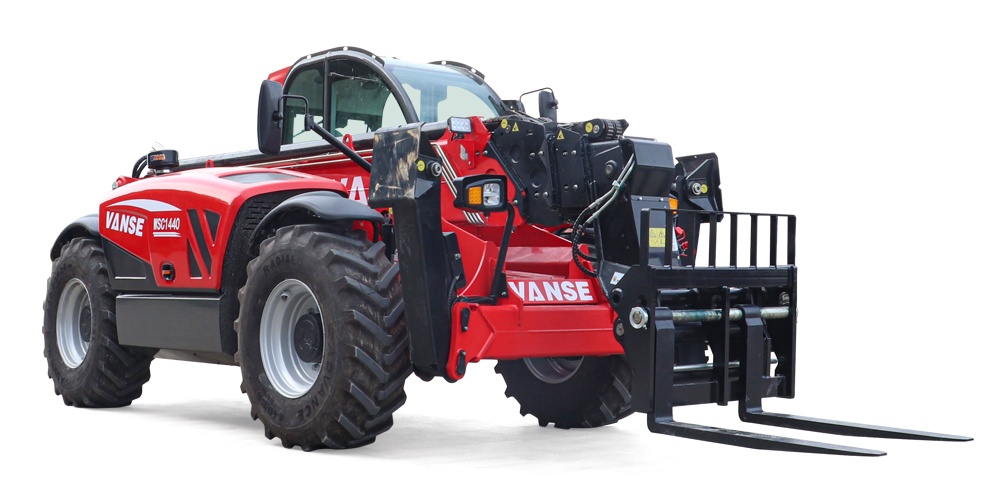
VANSE 735 7m Telescopic Handler
A balanced mid-duty solution for construction, agriculture, logistics, and warehousing, combining stable lifting, strong traction, and everyday versatility.


About the Author:
The VANSE team is a group of experienced professionals specializing in construction machinery research, manufacturing, and technical support. With deep industry knowledge and hands-on experience, our engineers and product specialists share practical insights on equipment selection, operation, maintenance, and industry trends.
Share
You May Also Interest
-

14 October, 2026
Telehandler for Cold Storage: Material Handling in Frost
Explore telehandler cold storage solutions in the United States, including suppliers, specs, costs, and buying tips for frozen warehouses and cold-chain operations.
-
13 October, 2026
2000 kg Telehandler: Compact Lifting for Tight Job Sites
Find the right 2000 kg telehandler in the United States with supplier comparisons, jobsite uses, buying tips, and support options for local buyers.
-
12 October, 2026
Telehandler vs Mast Forklift: Indoor vs Outdoor Lifting
Compare telehandler vs mast forklift in the United States for indoor and outdoor lifting, with buying tips, supplier options, and practical use cases.
-
9 October, 2026
Where to Buy a Telehandler: Smart Purchasing Tips Guide
Learn where to buy telehandler equipment in the United States, compare suppliers, models, pricing, service options, and smart buying tips for local buyers.