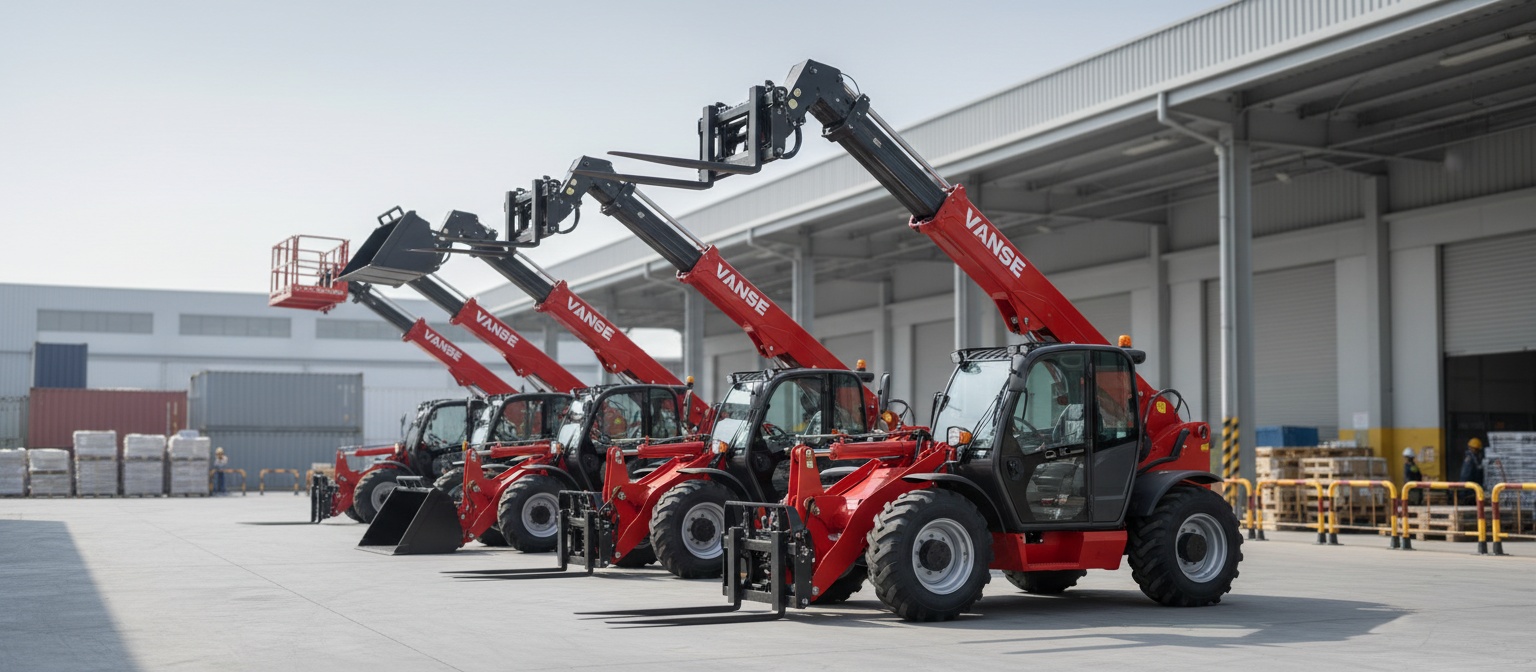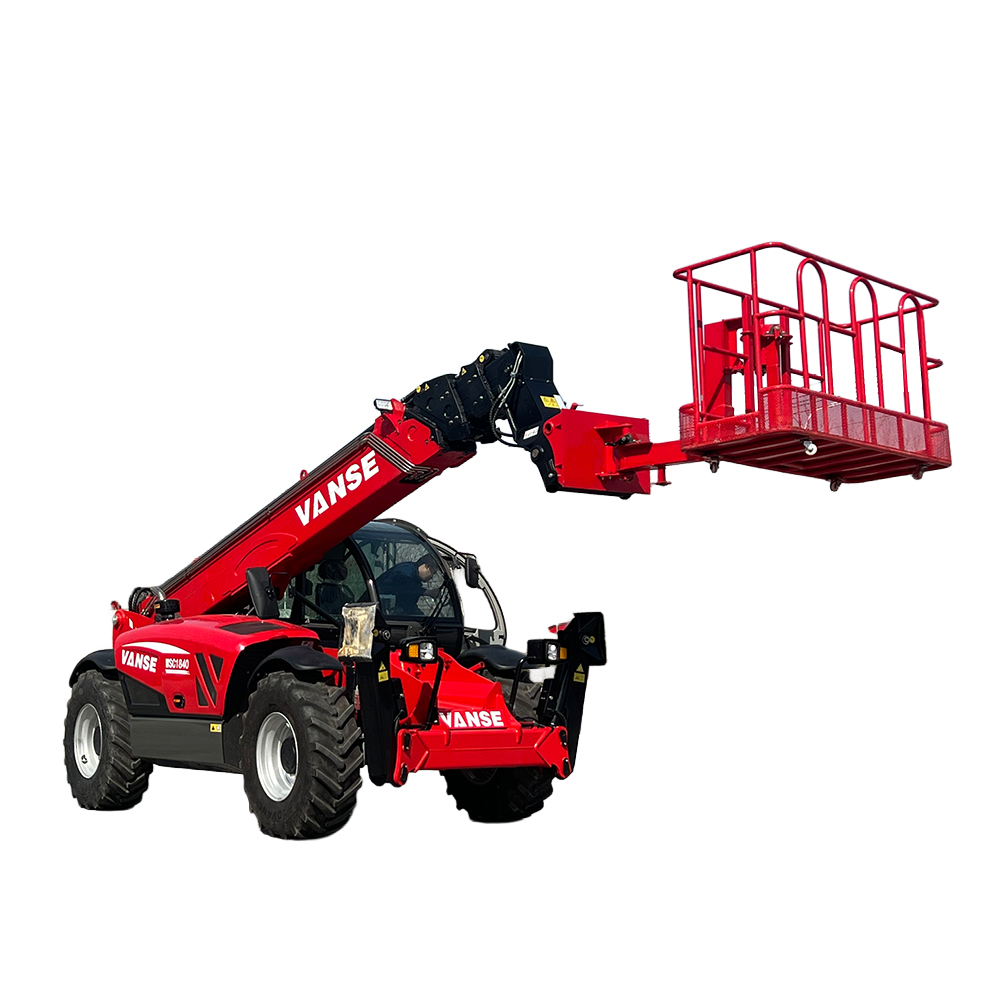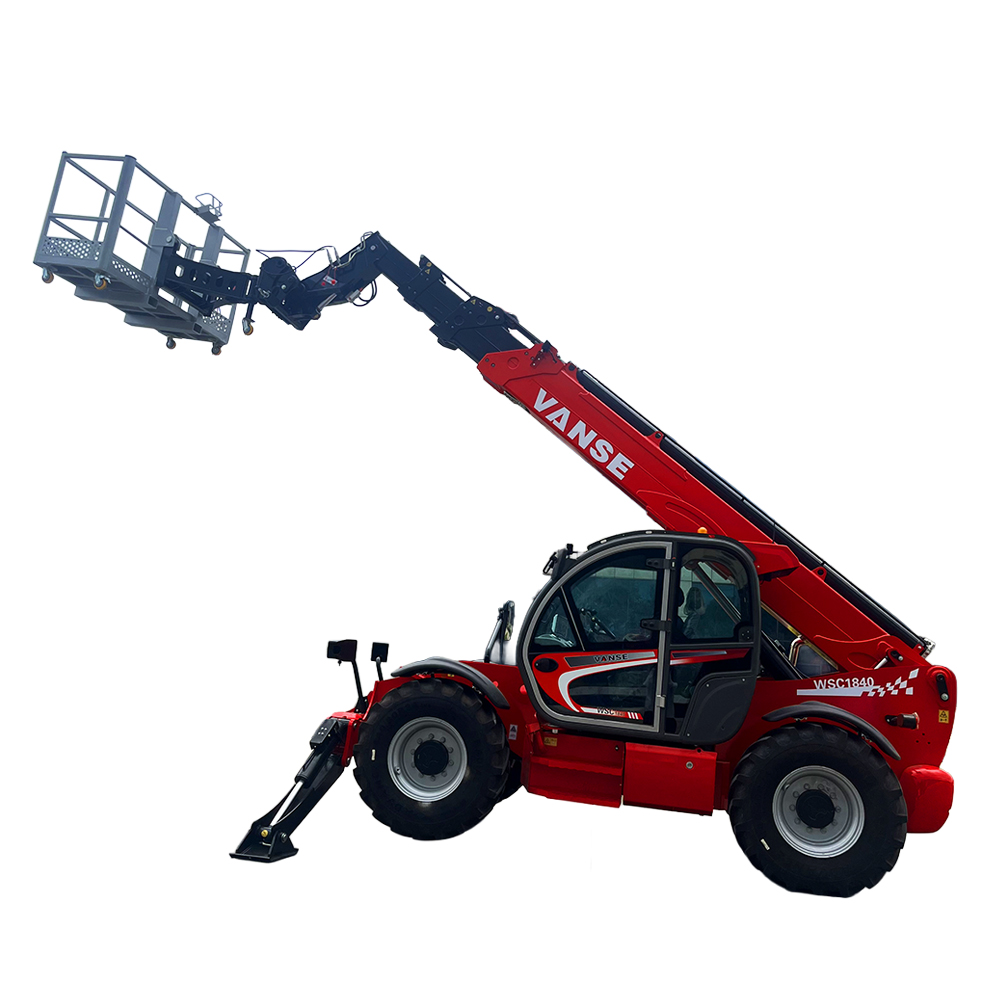
Telehandler Operating Weight: What Buyers in the United States Need to Know
Quick Answer

Telehandler operating weight is the total machine weight in working condition, typically including the base machine, standard boom, cab, fluids, and standard tires. In the United States, compact telehandlers often weigh about 10,000 to 18,000 lb, mid-size construction telehandlers commonly range from 20,000 to 30,000 lb, and high-capacity or high-reach models can exceed 35,000 lb. Machine weight matters because it directly affects transport permits, trailer selection, axle loading, ground pressure, jobsite access, and lifting stability.
If you are choosing a telehandler for U.S. jobsites, focus first on five points: whether your trailer and truck can legally move the machine; whether the machine’s weight matches slab, yard, or farm ground conditions; whether the operating weight supports the lift capacity and reach you need; whether the site has bridge, gate, and turning limitations; and whether service support is available near your location. Major suppliers with strong U.S. relevance include JLG, Genie, JCB, Caterpillar, SkyTrak, and Manitou. Qualified international suppliers can also be worth evaluating, especially when they hold recognized certifications, use globally proven components, and offer solid pre-sales and after-sales support with cost-performance advantages.
Why Operating Weight Matters in the United States

In the U.S. market, telehandler operating weight is not just a line on a specification sheet. It affects nearly every ownership and jobsite decision. A buyer in Houston handling pipe on industrial sites, a contractor in Dallas framing multifamily buildings, a grower in California moving pallets in orchards, and a rental fleet manager near Chicago all need to think differently about machine mass. The right weight can improve stability and attachment control, but the wrong weight can create transportation delays, damaged surfaces, or poor performance on soft ground.
For buyers across the United States, transport is often the first practical issue. A machine that fits your target lift chart may still require a heavier trailer, a different CDL setup, or route planning around bridge and axle restrictions. On urban jobsites in New York, Los Angeles, or Miami, that can increase delivery cost and reduce schedule flexibility. In agricultural regions such as Iowa, Nebraska, and California’s Central Valley, a heavier machine may offer strong lifting confidence but can leave deep rutting in soft ground after rain or irrigation.
Operating weight also influences jobsite safety. Heavier telehandlers generally provide a stronger base for lifting at height, especially when matched correctly to boom geometry and counterweight design. But weight alone does not guarantee safe performance. Buyers should assess rated load, maximum lift height, forward reach, tire type, and whether the machine is frame-leveling, rotating, or fixed-boom. The safest choice is the one whose weight, dimensions, and load chart match the actual tasks being performed.
Because the U.S. market includes ports, distribution hubs, farming operations, energy corridors, warehouse construction, and mixed-terrain development, buyers should evaluate operating weight in the context of where the machine will work most often. A telehandler serving the Port of Savannah or Port of Houston may face different ground conditions and handling patterns than a machine supporting roofing crews in Phoenix or precast installation in Atlanta.
Understanding What Telehandler Operating Weight Includes

Manufacturers may present weight figures in slightly different ways, so buyers should confirm definitions before comparing machines. In most cases, telehandler operating weight refers to the machine with standard equipment, fluids, and basic attachments or fork carriage, ready for normal use. Optional counterweights, outriggers, specialty tires, enclosed cabs, and extra attachments can change the final transport weight significantly.
In the U.S., sales teams, rental fleets, and transport providers usually care about several related weight terms:
- Operating weight: the machine as equipped for work with standard fluids and standard configuration
- Shipping weight: the machine without some fluids or with a reduced transport setup
- Gross vehicle weight during transport: machine plus attachment plus trailer loading effect
- Axle load: the actual load carried by each axle, important for legal transport and ground impact
- Loaded working condition: machine with a specific attachment and material load during operation
These distinctions matter because a buyer may assume a telehandler is easy to move based on brochure weight, only to discover that pallet forks, foam-filled tires, a larger bucket, or a work platform push transport requirements higher than expected.
Typical Weight Ranges by Telehandler Class
The table below gives practical weight ranges commonly seen in the U.S. market. Actual figures vary by manufacturer and configuration, but these ranges help buyers compare categories.
| Telehandler Class | Typical Operating Weight | Typical Lift Capacity | Typical Lift Height | Common U.S. Uses | Weight Impact |
|---|---|---|---|---|---|
| Compact telehandler | 10,000 to 18,000 lb | 4,000 to 6,000 lb | 15 to 30 ft | Landscaping, light construction, farms, indoor-outdoor yards | Easier towing and better access in tight sites |
| General construction telehandler | 20,000 to 26,000 lb | 6,000 to 10,000 lb | 35 to 45 ft | Framing, masonry, roofing, commercial build-outs | Balanced transportability and jobsite stability |
| High-reach fixed boom telehandler | 26,000 to 35,000 lb | 8,000 to 12,000 lb | 50 to 70 ft | Multi-story construction, steel and facade work | Requires more transport planning and site access review |
| High-capacity telehandler | 30,000 to 45,000 lb | 12,000 to 20,000 lb | 35 to 56 ft | Industrial yards, ports, heavy material placement | Higher axle loads and stronger ground requirements |
| Rotating telehandler | 24,000 to 44,000 lb | 8,000 to 15,000 lb | 55 to 100 ft | Urban sites, crane replacement tasks, restoration work | More versatile but often heavier and more complex to transport |
| Agricultural telehandler | 16,000 to 28,000 lb | 5,500 to 9,000 lb | 20 to 35 ft | Feed handling, bale stacking, pallet movement | Weight must match soil conditions and yard surfaces |
This table shows that weight scales with capability, but not in a perfectly linear way. A well-designed 24,000 lb machine may outperform a heavier older unit because boom design, hydraulics, and chassis engineering are equally important. That is why buyers should compare real load charts rather than relying on weight alone.
U.S. Market Conditions and Demand Outlook
Demand for telehandlers in the United States continues to be supported by warehouse construction, infrastructure packages, energy projects, suburban development, and large-scale agriculture. The strongest demand pockets remain in Texas, Florida, California, Georgia, North Carolina, Arizona, and major Midwest distribution corridors. Rental companies also continue to influence buying behavior because many end users benchmark machine value based on residual strength, serviceability, and operator familiarity.
Weight-related preferences vary by region. Contractors in dense metro markets often want strong reach in the lightest package possible. Agricultural users may prefer a machine heavy enough to remain planted when handling feed, seed, and bulk materials but not so heavy that it tears up yards. Industrial buyers near Gulf Coast and Great Lakes logistics hubs may prioritize heavy-duty units with robust frames, larger tires, and dependable counterweight design.
The following chart illustrates a realistic view of telehandler market growth in the United States.
How Weight Affects Key Buying Decisions
Operating weight changes ownership cost in ways many first-time buyers underestimate. A machine that is only a few thousand pounds heavier may require a larger truck, a higher-capacity trailer, additional permits in some states, or a more expensive yard setup. This is especially relevant for contractors moving equipment between jobs every week.
Weight affects the following buying decisions most directly:
- Transport setup, including truck class, trailer rating, chains, and route planning
- Ground pressure on concrete, asphalt, gravel, finished landscaping, and wet soil
- Counterweight effectiveness and overall machine stability during lifting
- Fuel use and tire wear over long shifts
- Storage yard requirements and loading dock access
- Ability to use certain attachments without compromising safe operation
For example, a masonry contractor in Nashville may decide that a 10,000 lb lift-capacity machine is ideal for pallets of block, but if most jobs are short duration and spread across several counties, a slightly lighter model with better transport efficiency may deliver a lower total cost of ownership. Conversely, a precast crew in New Jersey may benefit from a heavier machine because the work is repetitive, concentrated on one site, and demands stronger material placement confidence.
Product Types and Their Weight Profiles
Different telehandler categories distribute weight differently, and that affects handling, visibility, and site suitability. Fixed-boom units remain the most common in the United States because they are simpler and typically more cost-effective. Rotating telehandlers are growing in interest on urban and specialty jobsites because they can reduce repositioning, but they tend to be heavier and more expensive. Agricultural telehandlers often prioritize maneuverability, lower cab height, and loader-style versatility.
| Product Type | Weight Characteristic | Best Site Conditions | Main Attachment Use | Buyer Profile | Practical Trade-Off |
|---|---|---|---|---|---|
| Fixed-boom compact | Lower machine weight and shorter wheelbase | Tight yards, barns, residential sites | Forks, light buckets, small jibs | Small contractors, farms, landscape suppliers | Good mobility, lower max reach |
| Fixed-boom standard construction | Moderate weight with balanced lift geometry | Commercial jobsites and rental fleets | Forks, truss booms, buckets | General contractors, rental houses | Most versatile category |
| High-reach fixed-boom | Heavier chassis for boom support | Mid-rise and facade work | Forks, work platforms, lifting hooks | Steel, framing, roofing specialists | Higher transport and service cost |
| Rotating telehandler | High weight due to turret and stabilization systems | Congested urban sites and restoration projects | Winches, baskets, forks, jibs | Specialty contractors | Maximum flexibility, more complexity |
| Agricultural telehandler | Weight tuned for yard traction and livestock/farm duty | Farms, feedlots, produce facilities | Buckets, bale clamps, forks | Farm operators and ag dealers | Great utility, may be less ideal for tall commercial work |
| Heavy industrial telehandler | Substantial weight and reinforced structure | Ports, oil and gas, pipe yards, factories | Heavy forks, hooks, large buckets | Industrial end users and infrastructure firms | Strong load handling, reduced mobility on light surfaces |
The best product type depends on whether your priority is mobility, reach, attachment versatility, or maximum load support. Weight should be treated as a design outcome tied to intended use, not simply a number to minimize.
Industry Demand by Sector
In the United States, telehandler demand comes from several sectors that value different weight and performance profiles. Construction still leads, but agriculture, industrial material handling, and infrastructure are all significant.
This distribution helps explain why operating weight has become such an important sales question. Rental fleets often prefer machines that can satisfy broad customer demand while remaining practical to move across a region. Agricultural operators care more about daily yard utility and lower ground damage. Infrastructure and industrial users prioritize machine stability, attachment capability, and rugged frame design.
Applications Where Weight Changes Performance
Many buyers ask whether a heavier telehandler is automatically better. The practical answer is no. Performance depends on matching machine mass to application.
For framing and roofing, moderate operating weight is often ideal because the machine needs enough stability to place bundled materials at height without becoming too difficult to transport. For masonry, slab work, and steel support, a heavier machine can be beneficial because pallet and component weights are more demanding. In agriculture, a slightly lighter telehandler with good traction may outperform a heavier one when moving continuously across wet or uneven ground.
Common U.S. applications include unloading flatbeds at suburban housing developments, placing trusses on low-rise buildings, moving pallets of brick in commercial zones, cleaning livestock areas, loading feed, transporting irrigation materials, supporting pipe work near refineries, and handling maintenance loads at manufacturing sites. In each case, machine weight affects how the machine interacts with soil, pavement, ramps, trailers, and stockyards.
Buying Advice for U.S. Buyers
Before requesting quotes, define the job instead of the machine. Start with your heaviest typical load, your highest placement point, your average travel surface, and your normal transport route. Then look at machine weight as a constraint and a support factor, not just a specification.
Use this practical checklist:
- Confirm operating weight with the exact tire, cab, and attachment configuration you expect to use
- Ask for axle load data if you work on sensitive surfaces or transport frequently
- Review load charts at the reach and height you actually need, not only maximum rating
- Check whether your truck and trailer combination stays legal across the states where you operate
- Ask local dealers about common maintenance items, service response time, and parts availability
- Test visibility, turning radius, and ride quality because operator comfort affects productivity
If you buy for a rental fleet, consider whether operators unfamiliar with the machine can use it safely and intuitively. If you buy for a farm or industrial plant, consider attachment changeover time, daily service access, and how machine weight affects floors, yard surfaces, and feed lanes.
Comparison of Leading Suppliers Relevant to the United States
The U.S. market has several strong telehandler suppliers. The table below compares companies often considered by American buyers. Weight figures and product ranges vary by model family, so the purpose here is to show market position, service coverage, and typical strengths.
| Company | Service Region in the United States | Core Strengths | Key Offerings | Typical Buyer Fit | Weight-Related Advantage |
|---|---|---|---|---|---|
| JLG | Nationwide through broad dealer and rental networks | Strong brand recognition, rental fleet familiarity, broad support | Construction telehandlers, high-capacity models, attachments | General contractors, rental companies | Balanced machine designs with established transport expectations |
| Genie | Nationwide, especially strong in rental channels | Popular fleet choice, good operator familiarity, dealer coverage | GTH series telehandlers, support packages | Rental houses, commercial construction firms | Well-known standard classes for easy fleet planning |
| JCB | Strong presence across construction and agriculture markets | Wide model range, ag and construction crossover expertise | Loadall machines, ag telehandlers, compact options | Mixed-use contractors, farms, dealers | Good spread of weight classes for varied applications |
| Caterpillar | National support through dealer system | Dealer-backed service, strong industrial reputation | Construction telehandlers and attachment support | Contractors wanting integrated fleet support | Heavy-duty perception for demanding sites |
| SkyTrak | Strong in North America, especially jobsite and rental channels | High recognition in construction, straightforward product lineup | Conventional telehandlers for framing and material placement | Builders, roofers, rental users | Popular weight classes suited to mainstream construction work |
| Manitou | Nationwide with strong specialty and rotating machine presence | Rotating telehandlers, agriculture expertise, attachment versatility | Fixed-boom, rotating, and ag telehandlers | Specialty contractors, farms, urban projects | Broad capability from lighter ag units to heavier rotating models |
This table is useful because it connects operating weight to actual buyer scenarios. Companies with broader dealer networks often reduce risk for owners who move machines often and need quick parts access. Suppliers with specialty rotating or agricultural experience may be better for buyers whose work patterns fall outside standard construction lifting.
Supplier and Product Comparison by Capability
This comparison chart reflects a blended view of range breadth, service suitability, application flexibility, and value positioning for U.S. buyers. It does not replace a detailed quote process, but it shows that established domestic and international suppliers can both be practical options when support and specification alignment are strong.
Trend Shift in Buyer Priorities
Over the past few years, U.S. buyers have shifted from focusing mainly on maximum lift capacity to balancing transportability, total ownership cost, service support, and technology features such as load management and telematics. This has changed the way operating weight is evaluated.
This chart suggests that buyers increasingly want efficient machine design rather than simply more mass. They still value safe, stable lifting, but they also want better transport economics, easier site access, and lower operating cost.
Local Supplier Considerations by Region
Where you buy matters almost as much as what you buy. In the United States, service speed often depends on dealer density, parts stocking, and technician reach. Buyers near major freight and equipment corridors such as Houston, Savannah, Los Angeles, Chicago, Atlanta, and the Inland Empire usually have more options and faster logistics. Rural buyers may need to prioritize suppliers with stronger field support and mobile technicians.
| Region | Common Buyer Needs | Preferred Weight Profile | Popular Applications | Service Consideration | Local Logistics Note |
|---|---|---|---|---|---|
| Texas Gulf Coast | Industrial handling, construction, energy support | Mid to heavy machines | Pipe, steel, plant maintenance, commercial build | Fast parts and field service are critical | Port of Houston supports import and inland movement |
| Southeast | Warehouse growth, residential and commercial development | Mid-weight versatile machines | Roofing, framing, block, distribution centers | Dealer coverage affects uptime strongly | Savannah and Charleston support equipment flow |
| Midwest | Agriculture and mixed construction | Compact to mid-weight depending on season | Feed, pallets, machinery support, buildings | Seasonal support and tire choice matter | Chicago and rail hubs improve parts access |
| West Coast | Urban projects, logistics, agriculture | Compact, efficient, and specialty units | Produce handling, urban build-outs, yard movement | Emissions compliance and transport planning matter | Los Angeles and Oakland are major trade gateways |
| Northeast | Dense jobsite access and higher service expectations | Lower-footprint but capable machines | Urban renovation, facade, utility support | Dealer response time is a key buying factor | Port Newark and regional distribution support imports |
| Mountain and Plains | Ranches, infrastructure, remote jobsites | Durable machines with terrain stability | Bulk materials, fencing, road and bridge work | Mobile service coverage is essential | Long-distance transport raises ownership cost |
This regional view is important because there is no single ideal operating weight for every U.S. buyer. The correct choice depends on transport distance, average ground conditions, dealer footprint, and the balance between agriculture, industrial, and construction workloads.
Case Studies from Common U.S. Use Scenarios
A contractor in Atlanta working on low-rise apartment projects often moves between sites weekly. Their team originally considered a heavier 12,000 lb capacity model for every task, but transport costs and restricted access at smaller sites made that impractical. By selecting a mid-weight telehandler with enough real-world reach for framing bundles and palletized materials, they reduced hauling cost and improved fleet utilization.
A feed operation in Kansas needed a telehandler for daily bucket loading, bale movement, and pallet handling. The owner first focused on lift height, but field testing showed that operating weight and tire setup had a larger effect on yard performance. A machine with moderate weight and strong traction delivered better all-season usability than a heavier model that compacted wet ground too aggressively.
An industrial service company near Houston selected a heavier telehandler because most work involved pipe, fabricated steel, and stable operation on prepared surfaces. In this case, added operating weight improved confidence in repetitive lifting and reduced the need to outsource heavier picks. The machine’s higher transport cost was acceptable because jobs lasted longer and were concentrated in one corridor.
A rental fleet in Florida chose standard mid-weight units over more specialized heavy machines because broad customer demand centered on framing, roofing, and general material placement. The fleet manager found that familiar operating weight classes helped simplify dispatch, trailer matching, and customer training while protecting resale value.
How to Evaluate Attachments Alongside Machine Weight
Attachments can materially change the performance and utility of a telehandler, but they also affect effective operating weight and stability. Forks are the baseline for most construction users, yet many owners also need buckets, truss booms, lifting hooks, work platforms, bale handlers, or specialty clamps.
Each attachment changes center of gravity, forward load distribution, and transport mass. A machine that feels ideal with forks may perform very differently with a large bucket or suspended hook. That is why buyers should request attachment-specific load charts and not assume all configurations behave the same way. This is especially important for fleets serving mixed applications across farms, contractors, and industrial accounts.
Our Company
For buyers evaluating alternative supply channels, VANSE presents a practical option for the United States telehandler market because its core product line is focused on telescopic handlers rather than being a minor add-on to unrelated equipment. The company manufactures under CE and ISO 9001 certified processes, uses internationally recognized core components such as Perkins and Cummins engines together with premium hydraulic systems, transmissions, and axles, and subjects each machine to load testing, safety inspection, and performance validation before shipment, which gives U.S. buyers concrete evidence on reliability and manufacturing discipline rather than marketing claims alone. VANSE supports multiple cooperation models through equipment solutions suited to end users, distributors, dealers, brand owners, and individual buyers, with OEM and ODM programs, wholesale supply, retail opportunities, and regional partnership structures that allow machines to be adapted by specification, branding, color, and configuration for local demand. Just as important for trust in the U.S. market, the company already serves North America within a wider export footprint spanning more than 40 countries and over 8,000 cumulative units, is actively establishing a U.S.-based subsidiary with local inventory and stocking, and combines online consultation with factory-backed technical support and growing offline after-sales capability, giving American buyers clearer protection than a remote exporter model; prospective partners can review the company through its company background, explore lifecycle support via service resources, or start a local discussion through the contact channel.
What to Ask Before You Buy
When comparing quotes from U.S. dealers or international suppliers, ask the same technical questions to all of them. This creates a better apples-to-apples comparison.
- What is the exact operating weight in the quoted configuration?
- What is included in the standard machine and what changes the transport weight?
- Can you provide fork, bucket, and jib load charts?
- What are the axle loads and tire options?
- What is the nearest parts stocking point to my city or state?
- How quickly can field service reach my site?
- What telematics, safety interlocks, and operator aids are included?
- How do warranty terms apply to commercial, rental, or agricultural use?
These questions help reveal whether a supplier truly understands the U.S. operating environment and whether the machine can be supported after delivery.
2026 Trends Shaping Telehandler Weight Decisions
Looking toward 2026, three trends will influence how U.S. buyers think about telehandler operating weight. The first is technology. More machines are being equipped with load management systems, telematics, camera packages, and improved operator interfaces. These features help fleets monitor usage, reduce misuse, and improve safety, allowing buyers to evaluate machine efficiency more precisely rather than defaulting to the heaviest available option.
The second is policy and compliance. State-level emissions rules, urban jobsite restrictions, and contractor reporting requirements are pushing buyers to think more carefully about fuel efficiency, fleet age, idle time, and jobsite suitability. In some applications, lower overall machine weight can improve transport efficiency and route flexibility. In others, a heavier machine with better duty-cycle durability may still offer the best lifecycle outcome.
The third is sustainability. Buyers increasingly look at tire wear, fuel burn, service intervals, lifecycle durability, and compatibility with cleaner driveline solutions. Weight optimization is becoming a design goal. Manufacturers are trying to maintain or improve lift performance while controlling unnecessary mass. This does not mean machines will simply become lighter across the board. Instead, the market is moving toward smarter weight distribution, stronger materials, and configurations tailored to use case.
For U.S. fleets, this means purchasing decisions in 2026 will likely center on the best capability-per-pound and best support-per-dollar equation rather than maximum size alone.
FAQ
What is considered a normal telehandler operating weight in the United States?
A normal range for mainstream U.S. construction telehandlers is around 20,000 to 30,000 lb, though compact machines may be much lighter and high-capacity or rotating machines can be much heavier.
Does heavier operating weight always mean better stability?
No. Stability depends on machine design, wheelbase, boom geometry, axle layout, counterweight, tires, and the specific load chart. More weight can help, but design quality matters just as much.
Why does telehandler operating weight matter for transport?
It affects truck and trailer selection, legal road compliance, axle loading, route planning, and transport cost. A few thousand extra pounds can change logistics significantly.
Should farmers prioritize lighter telehandlers?
Not always. Farms often need enough machine mass for confident bucket and bale handling, but excessive weight can damage wet yards and soft ground. The right balance depends on soil conditions and daily tasks.
How do attachments affect operating weight?
Attachments add mass and can shift the machine’s center of gravity. Buyers should request load charts and transport information for the exact attachments they plan to use most often.
Are international telehandler suppliers suitable for U.S. buyers?
They can be, provided they offer recognized certifications, proven core components, strong technical documentation, parts planning, and dependable local pre-sales and after-sales support.
Which U.S. regions care most about telehandler weight?
All regions do, but it is especially important in urban construction corridors, long-distance transport markets, agricultural areas with soft ground, and industrial zones handling dense materials.
What is the safest way to compare telehandlers by weight?
Compare operating weight in the exact quoted configuration, check axle loads, review real load charts at working height and reach, and verify transport and service requirements before purchase.
Final Takeaway
Telehandler operating weight matters because it shapes transport legality, jobsite access, lifting stability, attachment performance, and total ownership cost. In the United States, the best machine is not simply the lightest or the heaviest. It is the one whose weight, reach, load chart, and support network fit the actual conditions in which you work. Buyers in construction, agriculture, industry, infrastructure, and rental should evaluate machine weight alongside service coverage, attachment needs, and realistic daily use. When that match is right, the telehandler becomes not just a lifting tool, but a more profitable and dependable asset.
Complete Telescopic Handler Equipment Portfolio
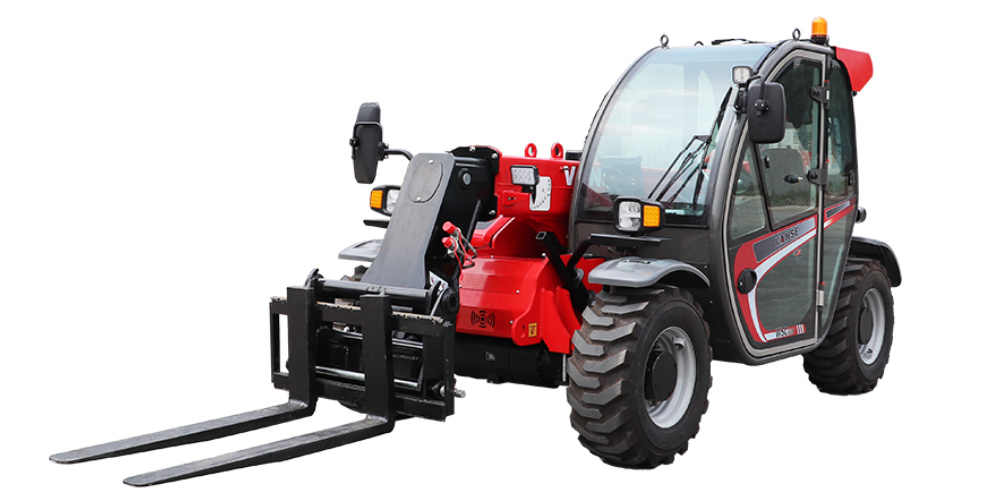
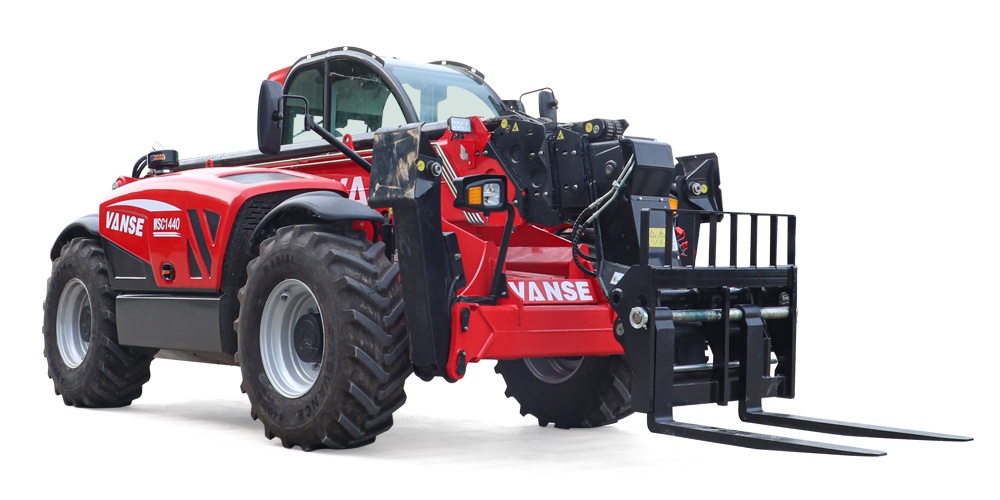
VANSE 625 6m Telescopic Handler
Designed for efficient material handling and stacking in warehouses, factories, and confined job sites, offering compact maneuverability and reliable performance.

VANSE 735 7m Telescopic Handler
A balanced mid-duty solution for construction, agriculture, logistics, and warehousing, combining stable lifting, strong traction, and everyday versatility.


About the Author:
The VANSE team is a group of experienced professionals specializing in construction machinery research, manufacturing, and technical support. With deep industry knowledge and hands-on experience, our engineers and product specialists share practical insights on equipment selection, operation, maintenance, and industry trends.
Share
You May Also Interest
-

1 October, 2026
Diesel vs Electric Telehandler: Power Source Comparison
Compare diesel vs electric telehandler options in the United States with costs, jobsite fit, suppliers, market trends, and practical buying advice.
-

30 September, 2026
How to Inspect a Telehandler Before Daily Operation Work
Use this telehandler daily inspection guide for the United States to check tires, forks, hydraulics, safety systems, and documents before each shift.
-

29 September, 2026
Telehandler for Solar Panel Installation on Large Sites
Explore telehandler solar installation solutions in the United States, including suppliers, machine types, buying tips, and service options for large solar sites.
-

28 September, 2026
8 Ton Telehandler: Maximum Power for Demanding Projects
Explore 8 ton telehandler options for United States buyers, including suppliers, specs, use cases, service factors, and smart purchasing guidance.