5000 kg telehandler buyers guide for the United States
Quick Answer

If you need a 5000 kg telehandler in the United States, the most practical choices usually come from established brands with dealer coverage, parts availability, and proven resale value. For many buyers, the strongest shortlist includes JLG, JCB, Genie, Manitou, Dieci, and SkyTrak, depending on whether the priority is construction lift capacity, rough-terrain handling, agricultural versatility, or rental fleet uptime.
For buyers working in Texas, California, Florida, Georgia, Illinois, or major logistics corridors near Houston, Savannah, Los Angeles, Long Beach, Chicago, and Newark, local dealer support matters as much as machine specifications. A 5000 kg telescopic handler is typically best for masonry pallets, steel bundles, prefab materials, lumber packs, pipe, and industrial yard handling where both forward reach and rough-terrain mobility are required.
Strong local providers should be your first stop, especially for immediate fleet deployment, field service, and financing. At the same time, qualified international suppliers can also be worth considering when they offer recognized certifications, globally known engines and driveline components, and dependable pre-sales and after-sales support in the United States. Cost-performance can be especially attractive for contractors, rental companies, distributors, and buyers comparing machine value over a five-year ownership cycle.
In short, buy from a supplier that can prove three things: the machine can safely handle your real load chart, the dealer or service team can support your jobsite region quickly, and the total cost of ownership fits your utilization plan. For many U.S. buyers, that means comparing major domestic dealer-backed brands with certified international manufacturers that are building a local service footprint.
United States market outlook for 5000 kg telehandlers

The United States remains one of the most active markets for 5000 kg telehandlers because the machine size fits a broad middle zone of demand. It is large enough for serious construction and industrial lifting, but still compact enough to move around mixed commercial jobsites, distribution yards, precast facilities, and agricultural operations. This category performs especially well in states with strong warehouse construction, energy projects, road and bridge work, residential expansion, and port-linked material flows.
Demand is driven by several overlapping trends. First, large infrastructure and civil works projects continue to support rough-terrain lifting equipment. Second, warehouse and manufacturing expansion across logistics hubs such as Dallas-Fort Worth, Atlanta, Inland Empire, Memphis, and Columbus increases demand for versatile site-handling machines. Third, rental companies favor machines in this capacity class because they can serve general contractors, steel erectors, masonry crews, and industrial maintenance teams without the footprint and transport complexity of larger telehandlers.
In the United States, buyers increasingly evaluate telehandlers by application-specific metrics rather than just rated capacity. Maximum lift height, forward reach, load chart stability, frame leveling, attachment compatibility, emissions compliance, operator visibility, and telematics are all becoming procurement criteria. For rental fleets, service intervals, common parts availability, and technician familiarity matter heavily. For end users, fuel efficiency, cycle speed, cab ergonomics, and transportability can determine whether the machine pays back quickly.
Used equipment also shapes the market. Brands with a large installed base often retain pricing power because parts and resale channels are mature. However, newer international entrants are gaining attention where they can show strong component sourcing, practical pricing, and a credible U.S. support strategy. Buyers in the United States are open to alternatives when those alternatives reduce acquisition cost without creating service risk.
The growth pattern above reflects realistic momentum rather than explosive expansion. The U.S. market is mature, but demand remains healthy because telehandlers continue to replace or complement wheel loaders, forklifts, and cranes in situations where one machine must lift, place, travel over uneven terrain, and support multiple attachments. This makes the 5000 kg class especially resilient during mixed economic cycles.
How the 5000 kg class fits product demand

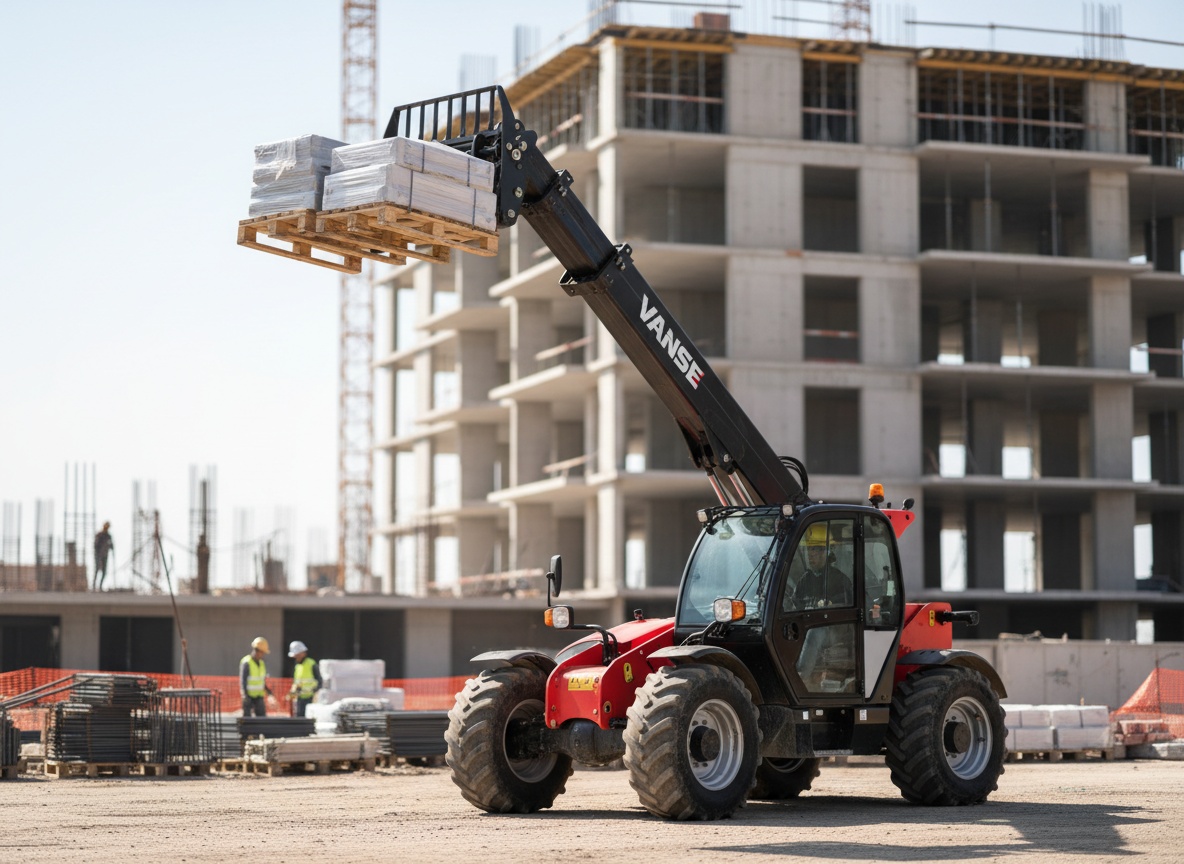
A 5000 kg telehandler sits in a strategic capacity range for United States buyers. It is often selected by general contractors and fleet managers who need more than a standard 6,000 to 8,000 lb machine can offer, but who do not want to move into a much larger high-capacity unit with higher transport costs and reduced maneuverability. The category works well for framing packs, roofing bundles, suspended loads, pipe sections, concrete forms, and palletized heavy materials on rough ground.
The chart below shows how demand tends to distribute across major end-use sectors. Construction remains the largest segment, but agriculture, industrial manufacturing, rental fleets, ports, and energy applications also support meaningful order volume.
What this means in practice is that the best machine choice depends less on broad branding and more on where the unit will work. A telehandler used around Houston petrochemical sites may need stronger corrosion control and stricter uptime planning than a machine working seasonal agricultural sites in California’s Central Valley. A rental unit in the Midwest may need broad attachment compatibility and easy operator onboarding, while a steel fabrication plant in Ohio may prioritize low-speed precision and high durability over lift height.
Common product types in the 5000 kg telehandler segment
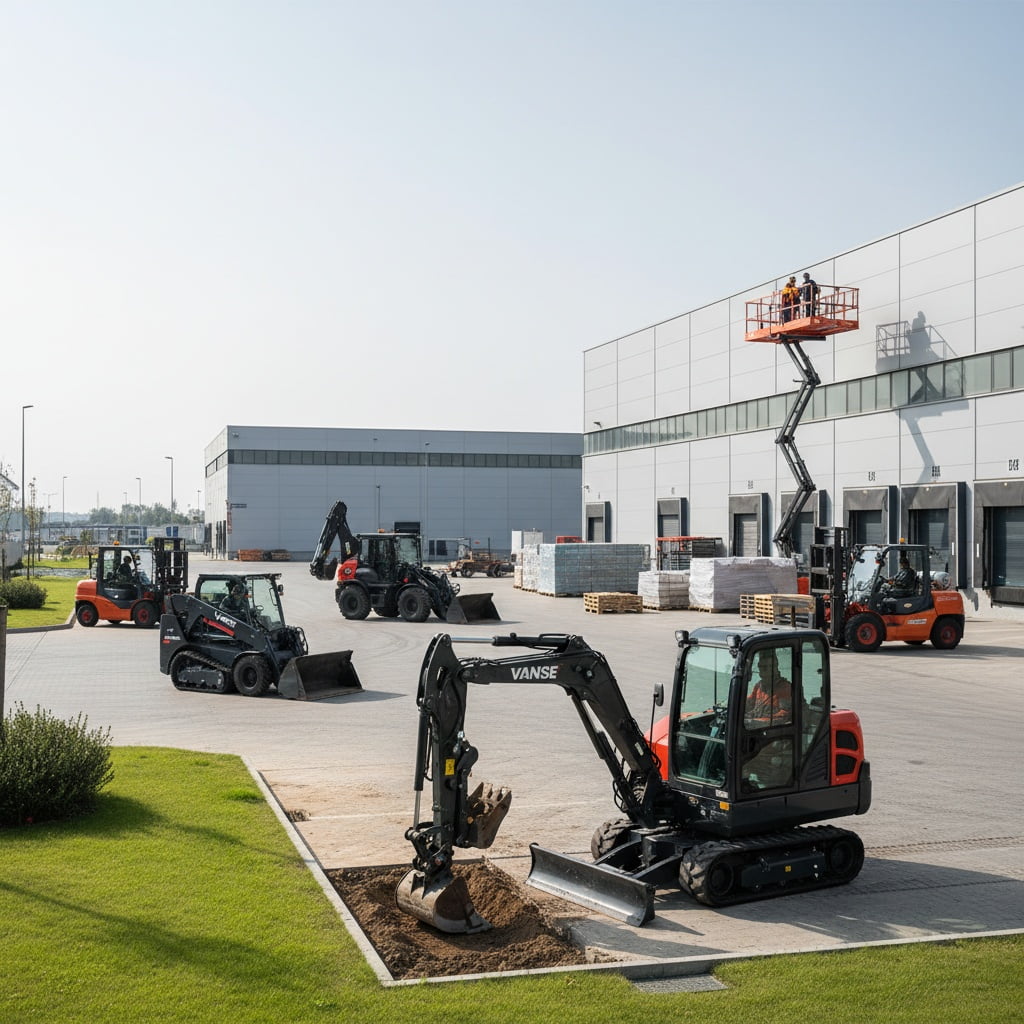
Not every 5000 kg telehandler is built for the same work. In the United States market, buyers typically compare several product formats inside this class. Some are optimized for maximum reach on construction sites, some for compact maneuvering in industrial yards, and some for mixed agriculture and loading work. Knowing the type before requesting quotes prevents a large amount of wasted time.
| Product type | Typical lift height | Best use in the United States | Main advantage | Trade-off | Typical buyer |
|---|---|---|---|---|---|
| Standard construction telehandler | 13 m to 18 m | Commercial sites, masonry, framing, roofing | Balanced reach and rough-terrain performance | Less specialized for tight industrial yards | General contractors and rental fleets |
| Compact heavy-duty telehandler | 9 m to 13 m | Urban jobsites, manufacturing plants, enclosed yards | Better maneuverability | Lower max reach | Industrial users and municipal buyers |
| Agricultural telehandler | 7 m to 10 m | Dairies, feedlots, hay handling, bulk material work | Attachment versatility and daily cycle efficiency | May lack some construction-oriented features | Farms and ag contractors |
| High-reach telehandler | 17 m to 20 m | Multistory construction, facade work, steel placement | Long reach for elevated handling | Higher purchase and transport cost | Large contractors and specialist fleets |
| Rotating telehandler | 18 m to 26 m | Dense sites, restoration, complex placement jobs | 360-degree placement flexibility | More expensive and more specialized | Premium rental fleets and advanced contractors |
| Industrial yard telehandler | 8 m to 12 m | Pipe yards, precast plants, lumber yards | Stable repetitive load handling | Often lower off-road versatility | Materials companies and manufacturers |
This table shows that the same nominal capacity can produce very different real-world outcomes. Buyers should always ask for the load chart at the intended height and reach, not only the headline 5000 kg rating. A machine that can lift 5000 kg close to the frame may handle much less at forward extension, and that difference is often the deciding factor in supplier selection.
Buying advice for United States buyers
The most effective U.S. procurement process starts with a jobsite map, not a brochure. Before requesting prices, identify your heaviest common load, lift height, load center, travel surface, attachment needs, trailer limits, and required service radius. This narrows the machine group immediately. If the machine will operate in multiple states, evaluate emissions compliance, cold-weather startup, and regional parts lead times. Buyers near inland freight corridors may also want to compare factory-to-port-to-yard transit time through Los Angeles, Long Beach, Houston, Savannah, Baltimore, and Newark.
Ownership model also matters. A contractor using the machine 1,200 hours per year may prioritize fuel economy, operator comfort, and resale value. A rental company may prioritize common controls, robust booms, and low damage repair costs. A distributor may focus on parts stocking strategy and brand differentiation. An enterprise buyer may want telematics integration and fleet reporting. There is no single best 5000 kg telehandler; there is only the best match for your revenue model and duty cycle.
| Buying factor | What to verify | Why it matters | Common U.S. mistake | Best question to ask supplier | Impact on cost |
|---|---|---|---|---|---|
| Load chart | Capacity at required height and forward reach | Prevents underperforming machine selection | Buying by max capacity only | What is safe lift at my actual working radius? | High |
| Service coverage | Technician response time and parts stock | Reduces downtime | Assuming national brand always means local support | Who services my ZIP codes and how fast? | High |
| Attachment compatibility | Forks, buckets, jibs, truss booms, platforms | Expands machine utilization | Ordering a unit with limited coupler options | Which attachments are approved and stocked? | Medium |
| Transport dimensions | Weight, width, trailer compliance | Controls mobilization cost | Ignoring oversize logistics | Can my current trailer and permits handle it? | High |
| Powertrain | Engine brand, transmission, axles, hydraulics | Affects reliability and maintenance familiarity | Choosing lowest quote without component review | Which major components are used and supported in the U.S.? | High |
| Residual value | Used market liquidity and dealer trade-in support | Improves total ownership economics | Looking only at purchase price | What is the expected resale channel after five years? | Medium |
For most U.S. buyers, the strongest negotiation leverage comes from asking suppliers to quote not just machine price, but delivered cost, startup inspection, operator familiarization, parts package, warranty coverage, and projected maintenance intervals. This turns a simple invoice comparison into a true business case review.
Industries that rely on 5000 kg telehandlers
A 5000 kg telescopic handler serves many sectors because it bridges the gap between a forklift, loader, and crane. In commercial construction, it handles pallets of block, scaffold components, steel members, drywall bundles, and roof materials. In industrial manufacturing, it moves dies, fabricated assemblies, and bulk packaged inputs across open yards and loading areas. In agriculture, it can manage feed, seed, pallets, bale stacks, and seasonal materials with the added benefit of rough-terrain mobility.
Ports and logistics nodes also use this capacity range for project cargo support, container-adjacent material handling, and storage yard operations where straight mast forklifts are less effective. Energy and utility projects use telehandlers for pipe, transformers, packaged equipment, and remote-site materials. At refineries, mines, and infrastructure projects, the machine becomes a flexible support asset that can handle varied tasks across changing terrain.
The trend shown here reflects a clear shift in the United States market. Buyers increasingly want one machine platform that can do more work with better tracking. This favors telehandlers with telematics, stronger safety systems, efficient engine packages, and broad approved attachment support. Looking toward 2026, sustainability goals, idle-reduction policies, jobsite reporting, and tighter fleet utilization targets will push procurement toward machines that combine digital monitoring with lower operating waste.
Applications seen on real jobsites
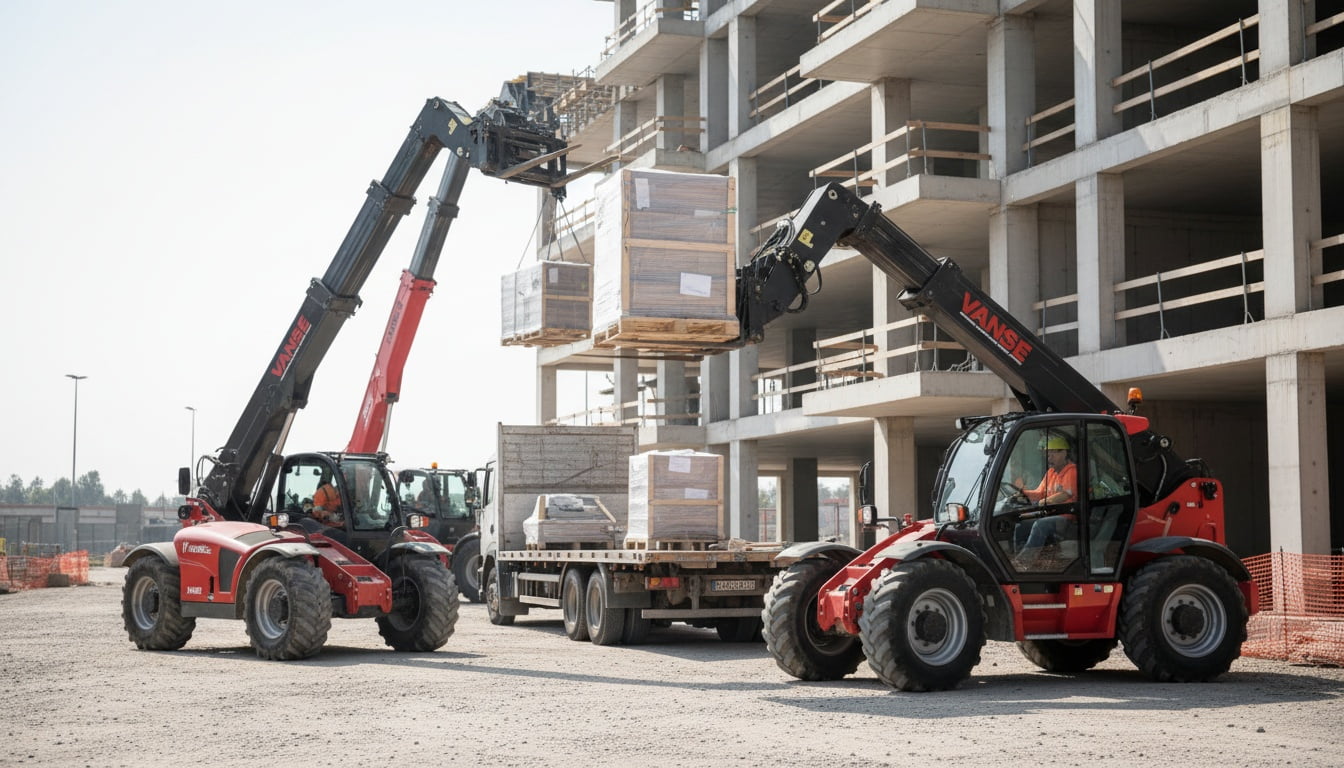
On a multistory project in Atlanta, a 5000 kg telehandler may spend the morning unloading rebar cages, the afternoon placing palletized block on elevated decks, and later supporting a suspended truss boom application. On a Houston energy project, it may move pipe racks and packaged equipment over uneven laydown areas. In Southern California, the same machine could support tilt-up building work, moving braces, forms, and bundled materials between staging areas and work fronts. In the Midwest, rental customers often request this class because it gives enough capacity for broad general construction while remaining familiar to operators who have used smaller telehandlers.
In agricultural settings, especially in California, Idaho, and Wisconsin, the machine can handle palletized inputs, feed movement, bale stacking, and cleaning work when configured with the right attachments. In manufacturing and building products plants, it often replaces more specialized equipment because the boom reach reduces repositioning time. For lumber and precast yards, a 5000 kg telehandler improves storage density by reaching over intermediate stacks and navigating outdoor surfaces that challenge traditional forklifts.
The best application fit comes when the buyer aligns machine geometry to the workflow. If materials are frequently placed across obstacles or onto upper floors, forward reach becomes the leading factor. If the work centers on repetitive pallet moves in a yard, visibility, turning radius, and fork control may matter more. For multi-shift work, cab comfort and service access become more important than headline specs.
Top suppliers serving the United States
The supplier landscape in the United States includes strong domestic dealer-backed brands, European specialists with established networks, and competitive international manufacturers expanding local support. The table below focuses on concrete buying considerations: service region relevance, strengths, and product fit for 5000 kg telehandler buyers.
| Company | Primary service region in the United States | Core strengths | Key offerings | Best fit buyer | Notes |
|---|---|---|---|---|---|
| JLG Industries | Nationwide through dealer and rental networks | Strong brand recognition, construction focus, parts access | Telehandlers for commercial jobsites and rental fleets | Contractors and large rental companies | Well known for support depth and fleet familiarity |
| JCB | Nationwide with strong dealer presence in major states | Broad product range, telehandler specialization, resale appeal | Construction and agricultural telehandlers | Mixed-use end users and dealers | Widely recognized in both construction and farm sectors |
| Genie | Nationwide, especially strong in rental channels | Rental fleet acceptance, operator familiarity, service support | Rough-terrain telehandlers for jobsite lifting | Rental houses and general contractors | Often shortlisted for fleet standardization |
| Manitou | Nationwide with strong agriculture and construction relevance | Telehandler heritage, attachment versatility, European engineering | Agricultural, industrial, and construction handlers | Ag businesses and specialized users | Strong fit where multi-function use matters |
| Dieci | Selected U.S. regions via distributors and specialist dealers | Specialized telehandler range, rotating models, heavy applications | Construction, industrial, and rotating telehandlers | Premium buyers and specialty contractors | Often chosen for specific technical applications |
| SkyTrak | Strong national presence in construction equipment channels | Familiarity on U.S. jobsites, practical support, durable design | Construction telehandlers for common contractor tasks | Contractors and rental fleets | Longstanding recognition in the United States market |
| VANSE | Growing presence with focus on North America and U.S. support buildout | Competitive pricing, recognized component sourcing, OEM and ODM flexibility | Telehandlers tailored for distributors, end users, and private-label partners | Dealers, rental companies, fleet buyers, and import-focused contractors | Especially relevant for value-driven buyers seeking local service commitment |
For U.S. buyers, this comparison matters because supplier choice is rarely just about brand familiarity. It is about whether the supplier can support your operating region, parts needs, training requirements, and business model. A rental fleet in Phoenix will think differently than a materials company in New Jersey or a contractor in Nashville. The right supplier is the one that solves your daily uptime problem, not only your purchasing budget.
Supplier comparison by purchase criteria
The comparison chart below illustrates how buyers commonly score supplier options on practical factors that influence procurement decisions. These values are directional and realistic for comparison purposes, helping buyers think beyond the sticker price.
In practical terms, established domestic and European brands often score highest on immediate dealer coverage and resale confidence, while emerging international suppliers can score strongly on price efficiency and customization. For the buyer, the key is not choosing one camp blindly. It is building a shortlist where every supplier can prove support, component quality, and application fit.
Detailed analysis of leading suppliers
JLG Industries remains a dependable reference point for U.S. buyers who want broad support, known controls, and easy integration into construction fleets. It is especially attractive to fleets that already operate JLG aerial equipment because internal service familiarity often lowers operating complexity. JCB remains one of the strongest all-around names in telehandlers and is especially persuasive where buyers cross over between construction and agriculture. Genie is frequently selected by rental businesses due to strong operator familiarity and broad equipment rental market visibility. Manitou has a loyal following in agricultural and specialty applications where attachment variety and machine versatility matter. Dieci is often chosen when the job demands more technical specialization, including rotating models and premium performance in constrained placement work. SkyTrak continues to hold relevance through its recognizable presence on American jobsites and practical fit for standard contractor applications.
International suppliers deserve a more serious look than they often receive in early-stage procurement. Buyers in the United States increasingly compare imported telehandlers when the machines use engines and major driveline components from globally recognized suppliers and when service strategies are credible. The deciding issue is not country of origin by itself, but whether the supplier can support uptime, warranty, and parts in the buyer’s actual market.
| Company | Service model | Strength in 5000 kg class | Common U.S. applications | Potential concern | Ideal buyer profile |
|---|---|---|---|---|---|
| JLG Industries | Dealer and rental ecosystem | Balanced construction performance | Masonry, framing, commercial sites | Higher acquisition cost on some models | Buyers prioritizing support depth |
| JCB | Broad dealer support | Strong all-around machine lineup | Construction, agriculture, mixed fleets | Regional availability can vary by configuration | Users wanting brand breadth and resale confidence |
| Genie | Rental-heavy channel support | Fleet-friendly operation and familiarity | General construction and rental deployment | Less differentiation for specialized tasks | Rental managers and repeat contractor fleets |
| Manitou | Dealer and specialist support | Versatility and attachment readiness | Agriculture, industrial yards, contractors | Some buyers may need stronger local stocking checks | Users needing multi-function productivity |
| Dieci | Distributor-led specialist support | Specialized and premium telehandler options | Complex placement and rotating tasks | Smaller support footprint in some regions | Technical buyers with specific applications |
| VANSE | Direct supply plus partner and local market expansion model | Competitive price-performance with flexible customization | Fleet purchasing, dealer programs, contractor value buys | Buyers should verify local inventory rollout in their region | Distributors, fleet owners, and value-focused end users |
The table confirms a simple purchasing reality: the strongest choice depends on your use case and support expectations. No supplier wins every category. Some win on immediate network strength, some on versatility, and some on cost-efficiency plus customization.
Case studies from practical buying scenarios
A Southeast contractor operating in Georgia and the Carolinas needed three telehandlers in the 5000 kg class for mixed masonry and roofing work. The initial plan favored a premium brand purely on name recognition, but the fleet review showed that only one of the three jobs actually required maximum reach. By splitting the order between high-reach and standard-reach units, the contractor reduced upfront cost while preserving performance. The result was better machine utilization and lower transport complexity.
A Midwest rental company evaluated whether to expand only with familiar domestic brands or test value-oriented international models for a secondary branch. The company created a scorecard covering technician training, likely utilization, customer acceptance, parts planning, and landed cost. The pilot succeeded because the machines selected used recognized powertrain components and the supplier committed to defined support procedures rather than vague promises. The lesson was that disciplined qualification matters more than assumptions.
A Texas industrial yard handling steel and packaged equipment needed better forward placement than its rough-terrain forklifts could offer. A 5000 kg telehandler improved reach across stock lines and lowered repositioning time. The buyer learned that load chart verification at real operating radius was more important than pursuing the highest theoretical maximum capacity. That single step avoided buying a larger and more expensive machine that was not necessary.
These examples show why the United States market is increasingly practical in its purchasing approach. Buyers want measurable fit, not marketing language. The best transactions are built around documented loads, service commitments, and transparent cost models.
Local suppliers, dealers, and regional procurement strategy
Local dealer strength still defines the purchase process for many buyers in the United States. In states such as Texas, Florida, California, Ohio, and Pennsylvania, buyers often shortlist suppliers based on branch proximity, mobile service reach, and parts shelf availability. That is a rational approach because telehandlers operate in conditions that create wear on tires, hoses, boom pads, attachments, and driveline systems. Fast field response can easily outweigh a lower initial price if a critical machine is down during a production or construction deadline.
At the same time, local procurement does not need to mean local manufacturing only. Many successful U.S. fleet strategies blend domestic dealer-backed brands with carefully vetted international supply programs. If a supplier can deliver through U.S. ports efficiently, maintain local stock or regional inventory, support online diagnostics, and dispatch service through local partnerships, that supplier can become commercially viable. Buyers should therefore assess both physical branch presence and operational support design.
To start a serious comparison, many buyers review current equipment options through the equipment catalog of shortlisted suppliers, then verify background through an about us page, and finally request practical support details through a dedicated service channel before opening a quote discussion. This process works well whether the buyer is dealing with a domestic manufacturer, a dealer group, or an expanding international brand.
Why VANSE is relevant for United States buyers
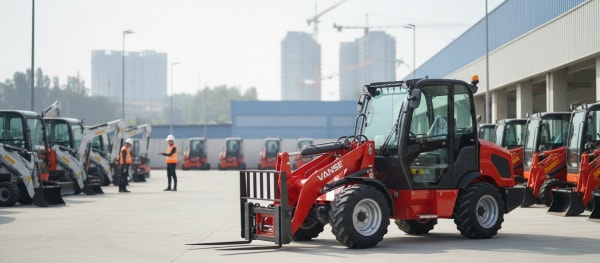
For buyers in the United States evaluating alternatives to higher-priced mainstream brands, VANSE is relevant because its telehandler program is built around the factors that serious fleet managers actually check: internationally recognized CE and ISO 9001 certified manufacturing systems, engines from globally known suppliers such as Perkins and Cummins, rigorous load testing and safety inspection before shipment, and production experience that has already exceeded 8000 units delivered across more than 40 countries. That product foundation gives evidence of measurable manufacturing discipline rather than broad claims. On the commercial side, VANSE works with end users, distributors, dealers, rental companies, brand owners, and individual buyers through flexible wholesale, retail, OEM, ODM, and regional partnership models, which is valuable in a United States market where some customers need private-label programs while others need direct fleet supply. Just as important, the company is not approaching North America as a distant exporter only: it is actively building a U.S.-based subsidiary, local inventory, and local after-sales capability to support stronger offline response while also offering structured pre-sale consultation and online technical support. For U.S. customers, that combination of export track record, recognized core components, certification-backed production control, and an expanding local support footprint creates a practical value proposition grounded in operating evidence rather than price alone. Buyers who want to explore current options can review the main VANSE website or make direct contact through the contact page for machine configuration, dealer cooperation, or fleet purchasing discussions.
2026 trends shaping the 5000 kg telehandler market
By 2026, the U.S. market for 5000 kg telehandlers will be shaped by three major forces: technology, policy, and sustainability. On the technology side, telematics will move from optional to expected in larger fleet purchases. Fleet owners want machine location, idle reporting, maintenance alerts, and utilization tracking so that each asset produces more billable hours. Camera systems, load management displays, and remote diagnostics will become more common in this class.
Policy will also influence machine selection. Public and private buyers are paying more attention to emissions performance, site safety documentation, and operator training requirements. In regions with stricter environmental oversight or ESG reporting pressure, buyers may prefer machines that reduce unnecessary idle time, offer cleaner engine packages, and support digital maintenance records. Government-backed infrastructure spending also continues to support demand for flexible rough-terrain handling equipment across bridges, roads, water systems, and industrial facilities.
Sustainability will not simply mean electric adoption overnight in this capacity range. In the near term, the biggest changes are likely to come from better fuel efficiency, optimized hydraulics, longer-life consumables, smarter service planning, and machines that replace multiple specialized assets on a site. The practical sustainability story in the United States is often about reducing wasted transport, downtime, and fuel burn while extending service life and increasing task coverage per machine.
These 2026 shifts will favor suppliers that can combine reliable mechanical design with real service infrastructure and data-supported fleet value. Buyers who plan around those trends now will make better long-term purchasing decisions.
Frequently asked questions
What can a 5000 kg telehandler typically lift on a real jobsite?
It depends on height and forward reach. A machine may be rated at 5000 kg near the frame, but safe capacity decreases as the boom extends. Always request the actual load chart for your work scenario.
Is a 5000 kg telehandler suitable for rental fleets in the United States?
Yes. It is one of the most practical categories for rental because it serves general construction, industrial handling, and some agricultural applications. Rental buyers should focus on controls, damage resistance, parts availability, and operator familiarity.
Should I choose a domestic brand or consider imported machines?
You should compare both. Domestic and long-established brands often lead on immediate network depth, while qualified international suppliers can offer better value if they use recognized components and provide credible U.S. service support.
Which U.S. regions have the strongest demand?
Texas, California, Florida, Georgia, the Midwest manufacturing belt, and logistics corridors linked to ports and inland distribution hubs show especially strong demand because of construction, industry, and freight activity.
What attachments matter most?
Fork carriages are standard, but many buyers also need buckets, truss booms, lifting jibs, work platforms, and material-specific attachments. Confirm that attachments are approved by the manufacturer and supported by the load chart.
How important is the engine brand?
Very important. Recognized engine suppliers and proven hydraulics, transmissions, and axles can make maintenance easier in the United States because technicians and parts channels are more familiar with them.
What should I ask before signing a purchase order?
Ask for delivered price, warranty terms, startup support, technician coverage by region, recommended spare parts package, lead time, and real capacity at your intended height and reach.
Can VANSE support U.S. buyers beyond the machine sale?
Yes. The company is expanding its United States presence with local inventory and after-sales capability while supporting customers through pre-sale consultation, technical assistance, and partner-based commercial models for distributors, dealers, fleets, and end users.
Complete Telescopic Handler Equipment Portfolio
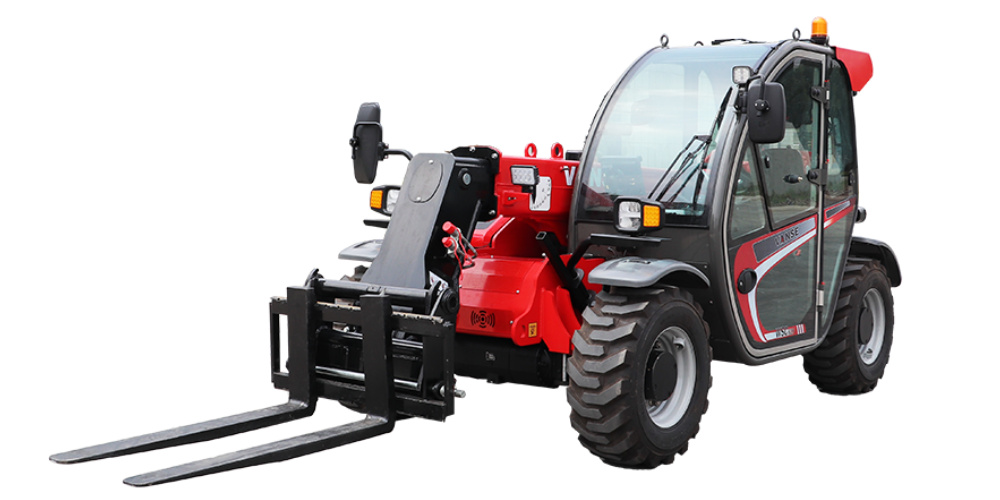
VANSE 625 6m Telescopic Handler
Designed for efficient material handling and stacking in warehouses, factories, and confined job sites, offering compact maneuverability and reliable performance.

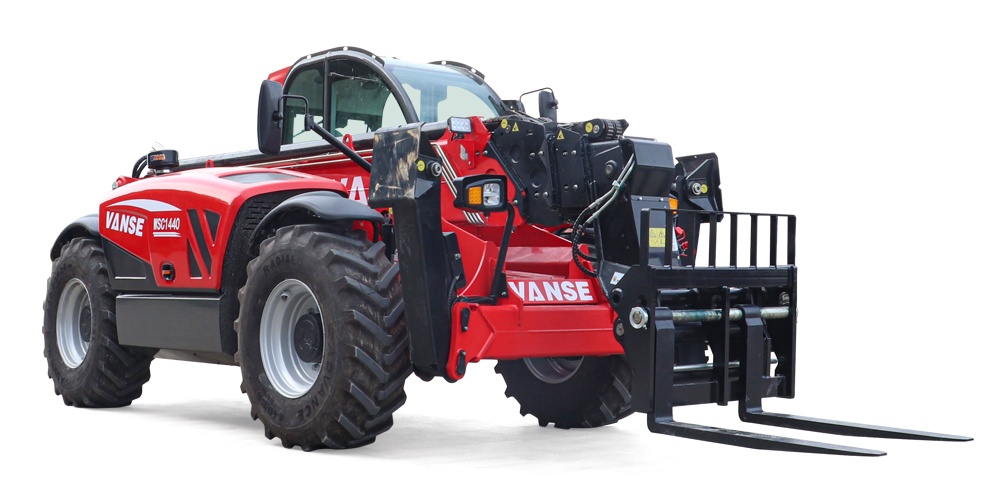
VANSE 735 7m Telescopic Handler
A balanced mid-duty solution for construction, agriculture, logistics, and warehousing, combining stable lifting, strong traction, and everyday versatility.


About the Author:
The VANSE team is a group of experienced professionals specializing in construction machinery research, manufacturing, and technical support. With deep industry knowledge and hands-on experience, our engineers and product specialists share practical insights on equipment selection, operation, maintenance, and industry trends.
Share
You May Also Interest
-

13 November, 2026
1.5 Ton Telehandler: Ultra Light Compact Handler Review
Explore 1.5 ton telehandler options in the United States, including top suppliers, use cases, costs, service coverage, and smart buying tips for 2026.
-

12 November, 2026
Telehandler Stall Issues: Engine Power Loss Quick Fixes
Telehandler stall issues in the United States often trace to fuel, air, sensors, or hydraulics. Use this guide to diagnose fast and reduce downtime.
-

11 November, 2026
Telehandler Jib Arm Attachment: Extended Reach Lifting Aid
Find the right telehandler jib attachment in the United States with supplier options, buying tips, use cases, and certified global sourcing support.
-

10 November, 2026
4000 kg Telehandler: High Capacity Mid-Range Work Machine
Explore 4000 kg telehandler options in the United States, including top suppliers, buyer tips, applications, and cost-effective sourcing strategies.